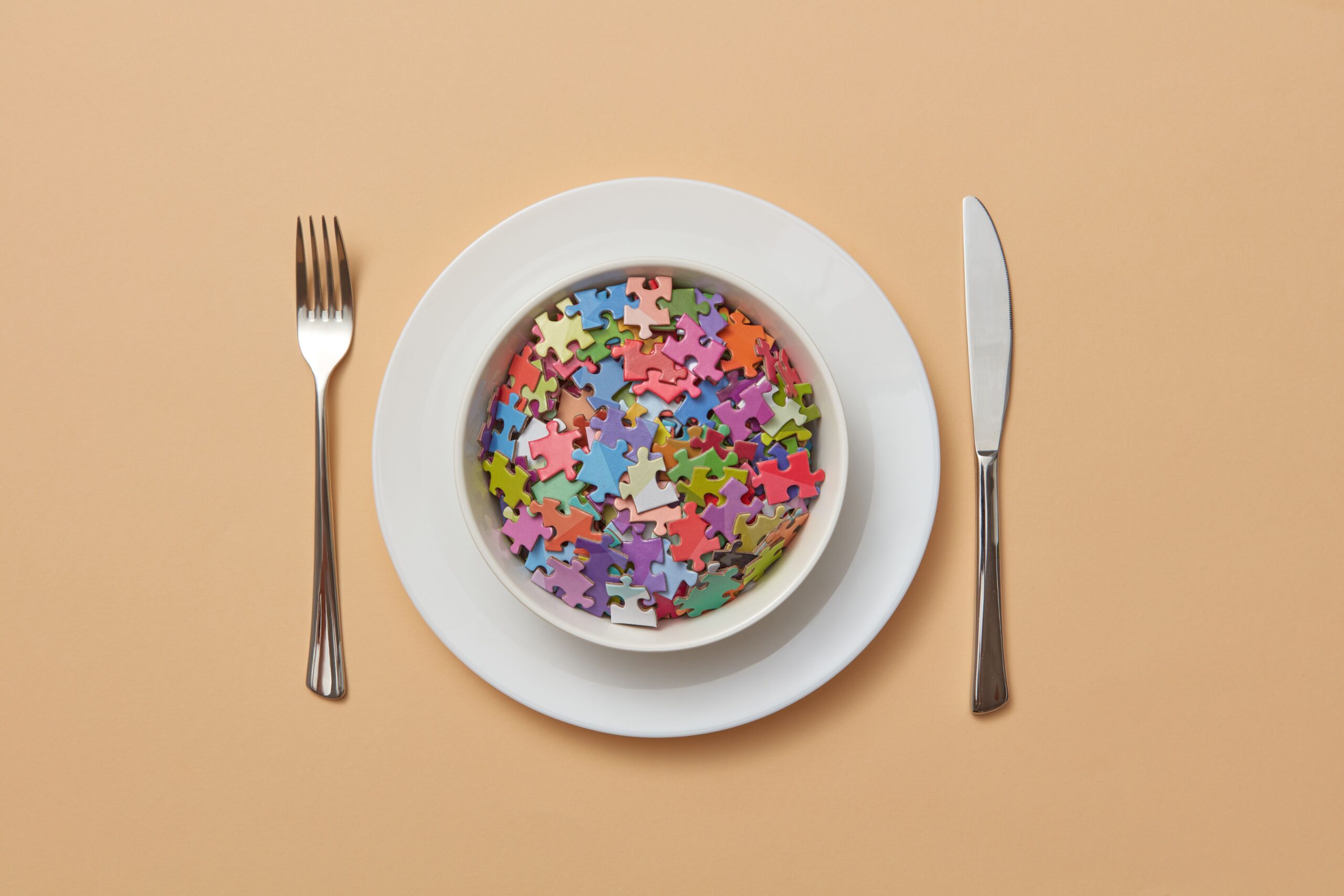
Food for Thought: The Importance of Nutrition in Huntington’s Disease
⏱️8 min read | What if nutrition is one of the warning lights we should be checking earlier in Huntington’s disease? New research suggests simple nutrition measures may help identify when people with HD need extra support.
Huntington’s disease (HD) can affect the whole body, not just the brain. It may change how the body uses energy, how safely a person can eat or swallow, and how much fuel the body needs each day. For some people, living with HD may be a bit like walking into a strong headwind, rather than a gentle breeze. They are still moving forward, but it takes more energy to do the same things.
You may have heard the saying, “you can’t run on empty.” A person living with HD may be eating regular meals, or even seem hungrier than before, but still lose weight, feel weaker, or have less energy. This can be worrying and confusing. It can also make families wonder: are we doing enough?
Living with HD can be like walking into a strong headwind: everyday tasks may take more energy than expected. The body may need extra fuel and support to keep moving forward. Photo credit: wal_172619
A new study by Xia and colleagues looked at nutrition in people with HD. The researchers wanted to know whether malnutrition is more common in HD, whether it is linked with symptoms such as movement and thinking changes, and whether simple nutrition checks might help care teams spot when extra support is needed.
Malnutrition ≠ undereating
First things first, what do the researchers mean by malnutrition? Malnutrition does not simply mean “not eating enough.” It can also mean the body is not getting, using, or holding on to the nutrients it needs. Someone may be eating, but still be at nutritional risk because their body needs more calories, because swallowing has become difficult, or because HD-related changes are making it harder to maintain weight and strength.
In other words, nutrition is not just about what is on the plate. It is also about what the body is able to do with it.
Applying nutritional tools
The study included 113 people with genetically confirmed HD and 113 people without HD for comparison. The two groups were statistically “matched,” helping to ensure that any differences seen were less likely to be explained by differences in age, sex, or body mass index (BMI). The researchers also used three common nutrition screening tools called the Controlling Nutritional Status (CONUT) score, Geriatric Nutritional Risk Index (GNRI), and Prognostic Nutritional Index (PNI). These tools use simple information from blood tests and body measurements, such as blood protein levels, cholesterol, white blood cell levels, and body weight.
A helpful way to think about these tools is like dashboard warning lights in a car. One warning light does not tell you the whole story, but it can tell you something needs attention. In the same way, nutrition scores cannot explain everything about a person’s health, but they can help flag when someone needs a closer look.
Applying HD tests and statistical tools
The team also measured symptoms using standard HD assessments, looking at movement, thinking skills, mood and daily functioning. Some participants were followed over time, for almost six years on average. The researchers also recorded how long participants lived after taking part in the study. In research, this is often called survival time, but in this context it means the time until a person living with HD passes away. Although this outcome may be difficult to talk about, it is an important one. It helps researchers understand whether nutrition is linked not only to symptoms, but also to how long people live with HD, and whether better nutritional support may make a meaningful difference to people’s lives.
The study also used a genetics tool called Mendelian randomisation. This is a way for researchers to look for clues about cause and effect. We are all born with small genetic differences, a bit like being dealt a hand of cards before life begins. We do not choose these cards, and they are there before environmental influences like diet, exercise, or lifestyle can affect us. Researchers can use these “genetic cards” to ask questions like: are people who naturally have higher levels of a certain substance in the body also more likely to have slower or faster HD changes?
Like cards being randomly dealt, genes are randomly inherited. Mendelian randomisation uses this natural process to help researchers understand possible links between nutrition and HD outcomes. Photo credit: Archana GS
In this study, the researchers used this method to look at factors linked with nutrition, such as body weight, cholesterol, and lymphocytes, which are a type of white blood cell.
What can nutrition scores tell us?
The researchers found that signs of malnutrition were more common in people with HD than in people without HD, although interestingly, the results depended on which tool was used.
Using the CONUT tool, about 35 out of every 100 people with HD showed signs of malnutrition. In the comparison group, this was about 13 out of every 100. Using the GNRI tool, about 8 out of every 100 people with HD showed nutrition risk, compared with about 3 out of every 100 people without HD.
The tools did not all give the same answer. This matters. Nutrition in HD is not simple, and different tools may detect different signals. One tool may be more sensitive to changes in blood markers. Another may better reflect body weight and protein stores. It is a bit like looking in at a house through different windows. Each window shows part of the room, but not the whole home.
The clearest clinical links were seen with the GNRI score. People with poorer nutrition scores on this test tended to have more advanced HD, lower daily function, and poorer thinking test scores. In everyday language, people with more nutrition risk were also more likely to have difficulties with daily tasks and thinking.
Importantly, this does not prove that poor nutrition causes HD to get worse. The relationship may go both ways. HD can make eating, swallowing, and weight maintenance harder. At the same time, poor nutrition may leave the body with less reserve to cope.
Nutrition and survival: any connection?
One important finding was that nutrition scores did not clearly predict survival on their own. In other words, the study did not show that malnutrition by itself could predict who would live longer or shorter.
Supporting the body’s fuel tank may help people with HD face each day with a little more reserve.
This is important to clarify. Many things can affect health and independence, This is important to clarify. Many things can affect health and independence, including the length of the CAG expansion in the huntingtin gene, movement symptoms, swallowing problems, infections, falls, mood, thinking changes, and care needs. Nutrition is one important piece of the puzzle, but it is not the whole puzzle.
What about our body’s defence systems?
The genetics part of the study found an interesting link with lymphocytes. Lymphocytes are a type of white blood cell that help defend the body, a bit like security guards in the immune system. The researchers looked at genetic differences linked with lymphocyte levels and compared them with the age at which people with HD reached a certain level of movement symptoms. People who were genetically more likely to have higher lymphocyte levels tended to reach that stage later.
One way to think about this is that a stronger or better-preserved “security team” may help the body cope for longer. However, this study cannot prove that lymphocytes themselves slow HD progression.
It also does not mean that boosting lymphocytes is a proven treatment. Instead, it suggests that nutrition, the immune system and HD progression may be connected in ways that deserve more research.
What does this mean for families?
The main take-home message is that nutrition should be watched early and often in HD. A person with HD may need more calories than expected, even if they seem to be eating enough. Weight, appetite, swallowing, food intake, blood tests, and energy needs can all change over time. These changes are worth bringing up with the HD care team. Families can ask about regular weight checks, dietitian support, swallowing reviews, high-energy meals, nutritional supplements, and safe eating plans.
Importantly, these changes are no one’s fault – they are rooted in biology, and food is not a cure for Huntington’s disease. But good nutrition may help protect a person’s energy levels and quality of life. As the saying goes, “you cannot pour from an empty cup.” Supporting the body’s fuel tank may help people with HD face each day with a little more reserve.
We sincerely thank the people living with HD and the families who took part in this research. We also thank Xia et al., for helping to highlight why nutrition matters in Huntington’s disease care.
Summary
Malnutrition does not simply mean “not eating enough.” It can mean that the body is not getting, using, or holding on to the nutrients it needs.
Malnutrition signs were more common in people with HD than in people without HD, although results varied depending on which nutrition screening tool was used.
Poorer nutrition scores were linked with more advanced HD, including lower daily functioning and poorer thinking test scores, suggesting nutrition should be monitored early and regularly.
Nutrition did not clearly predict survival on its own, but the study suggests nutrition, immune health and HD progression may be connected and deserve further research.
Please consider making a donation if you value the services that HDBuzz provides. We want HDBuzz to be sustainable so that we can continue to report unbiased science to the HD community.
With your support, we can ensure the continuity of our services. Nothing is expected, but everything is appreciated and sustains what we do at HDBuzz. Please consider giving what you’re able.
Please consider making a donation if you value the services that HDBuzz provides. We want HDBuzz to be sustainable so that we can continue to report unbiased science to the HD community. More information…