
Could Brain Waves Help Track Huntington’s Disease?
⏱️7 min read | A review of 23 studies found that EEG changes were linked to disease progression and clinical measures in HD. While more research is needed, EEG holds potential to become a simple, non-invasive biomarker for monitoring HD over time.
Electroencephalograms (EEG) are recordings of the brain’s electrical activity that are commonly used to monitor brain changes during the progression of neurological disease. A recent review paper examined what EEG has revealed about Huntington’s disease (HD) and found that changes in brainwave intensity may be reflective of how HD symptoms evolve. This suggests that EEG could potentially serve as a biomarkerbiomarker a test of any kind – including blood tests, thinking tests and brain scans – that can measure or predict the progression of a disease like HD. Biomarkers may make clinical trials of new drugs quicker and more reliable. or tool for studying how HD progresses over time.
Visualizing Brain Cell Communication
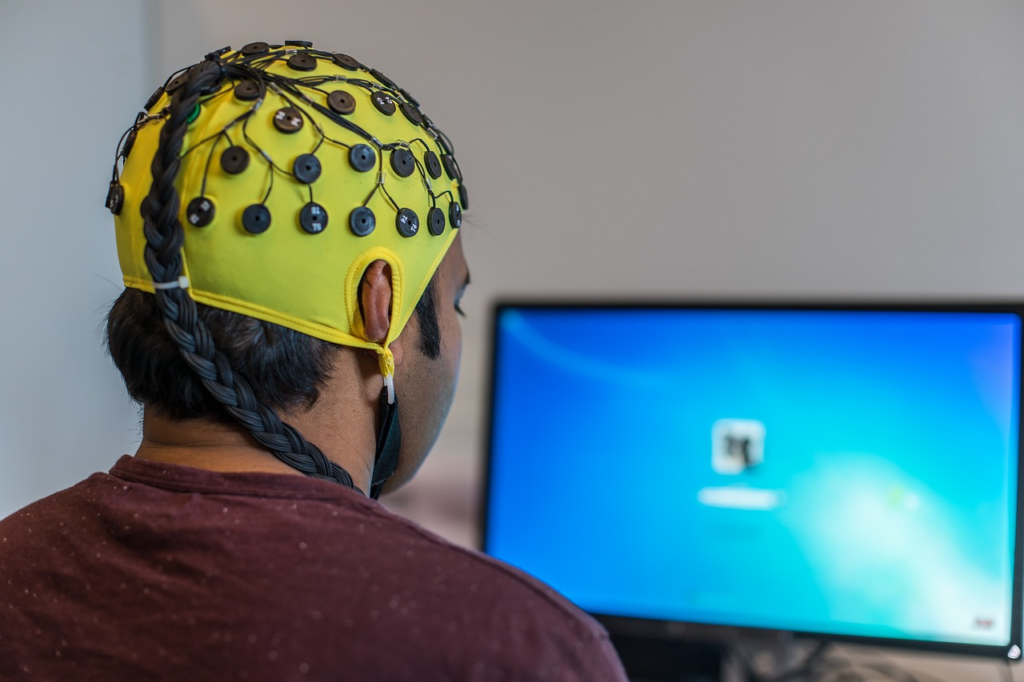
Our brain’s cells communicate through electrical signaling, which can be measured with devices called electroencephalograms (EEGs). This non-invasive procedure can be done easily by putting small electrodes on the scalp. By recording brain waves with EEG, researchers can ask whether brain cells are communicating differently in individuals with a neurological disease, or understand how patterns are changing over time.
Brain Waves in Health and Disease
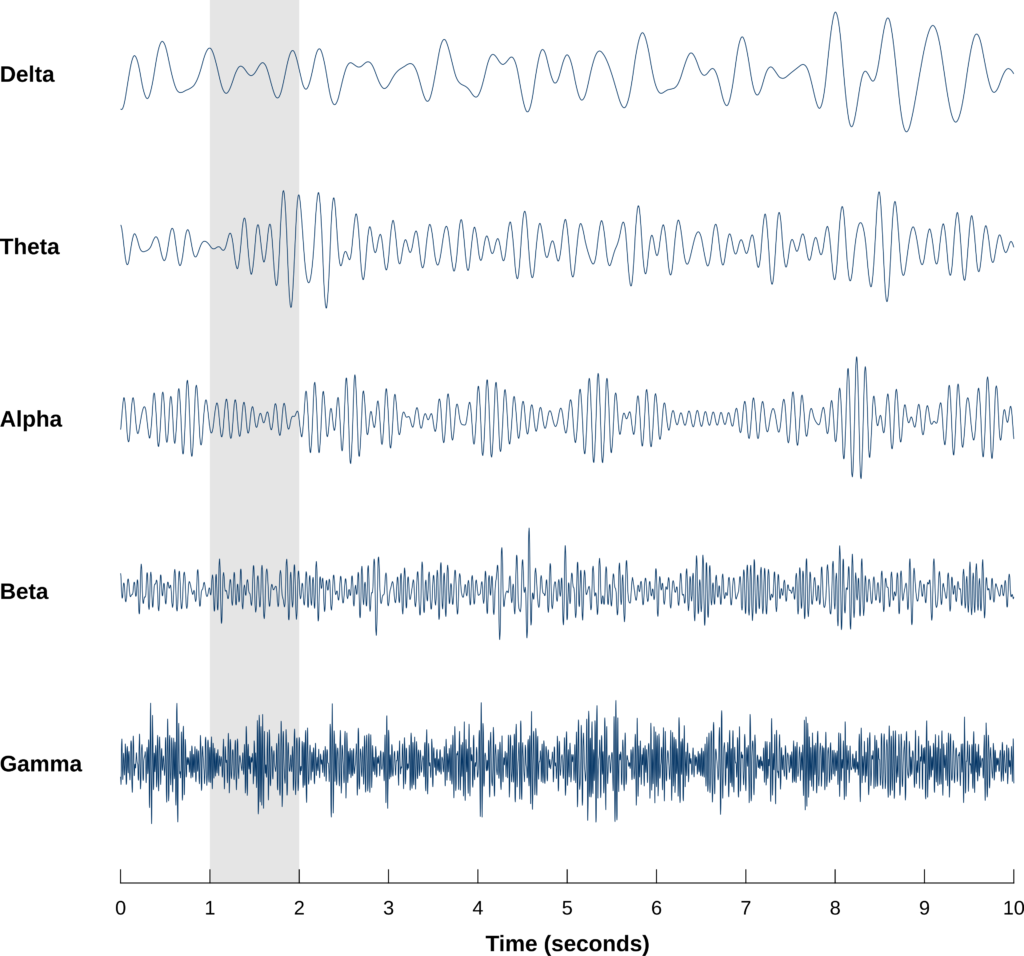
Electricity is typically measured through waves, and the brain operates at different wavelengths based on how active or restful it is.
- Gamma waves (30–100 Hz): The fastest brain waves, observed when you are active and engaged in problem-solving.
- Beta waves (12-30 Hz): The second fastest brain waves, occurring when you are alert and focused on a task.
- Alpha waves (8-12 Hz): Medium brain waves that indicate that you are awake but in a relaxed state.
- Theta waves (4-8 Hz): The second slowest brain waves, typically seen at the end of the day when you lay down to rest and fall into sleep and dreams.
- Delta waves (0.5-4 Hz): The slowest brain waves, often produced during deep, restorative sleep.
The brain can make multiple waves simultaneously, and EEG allows us to measure their intensity, more scientifically called power. Changes in the power of brain waves can reflect changes in the health of the brain. For example, when a group of neuronsneuron Brain cells that store and transmit information or circuits is degenerating, the power of the brain waves generated by those neuronsneuron Brain cells that store and transmit information may be reduced.
Brainwaves as observed through EEG have different frequencies, including Delta, Theta, Alpha, Beta, and Gamma waves.
Could EEG be used to track HD?
Researchers often begin with small studies to see if a tool like EEG will be useful to track a disease over time. While these experiments can be promising, the relatively small number of participants can make them difficult to interpret. To address this challenge, scientists can complete a “systematic review,” which is an organized way to evaluate and compare the results of many small clinical studies.
The results of a systematic review can be used to inform the field of what research directions have been most meaningful, and which should be continued. In the case of EEG, a broader view helps researchers determine whether these measures can reliably track changes over time and ultimately serve as a useful measure of disease progression, often known as a biomarkerbiomarker a test of any kind – including blood tests, thinking tests and brain scans – that can measure or predict the progression of a disease like HD. Biomarkers may make clinical trials of new drugs quicker and more reliable..
Many neurological diseases that affect the brain are linked with distinct changes in EEG patterns. In a recent systematic review of 23 HD EEG studies, researchers and clinicians from the USA and Iran found differences in resting-state and sleep EEGs in individuals with HD compared to healthy controls. Most of the research thus far has shown that EEG activity is altered in HD, tracking with early cognitive symptoms. The review identifies and delves into the specifics.
Brain Waves at Rest
Resting state refers to the brain’s baseline activity. It reflects when a person is relaxed and not engaged in any specific activity. In the systematic review, researchers found that there was consistently less alpha power and activity in the brains of people with HD. They also found that there was an overall increase in delta power. These changes in brain activity, along with others, suggest that there are widespread disruptions in the brain’s normal communication patterns, confirming that in HD, the brain is not functioning optimally.
Additional cognitive testing would be needed to determine how these EEG changes relate to thinking and behavior. While EEG abnormalities become more pronounced as HD progresses, it’s still unclear how soon they appear or whether they track with the earliest symptoms. Further research is needed to determine whether EEG could serve as a pre-symptomatic or early disease biomarkerbiomarker a test of any kind – including blood tests, thinking tests and brain scans – that can measure or predict the progression of a disease like HD. Biomarkers may make clinical trials of new drugs quicker and more reliable..
Sleep and Medication
During sleep our brain waves change significantly compared with those seen during daily activity. These changes are even more apparent during the course of neurodegenerativeneurodegenerative A disease caused by progressive malfunctioning and death of brain cells (neurons) diseases like HD, where sleep disturbances occur. This systematic review found specific alterations in sleep EEGs in people with HD, including a reduction in theta waves, which are typically most active during sleep.
Sleep changes occur during HD progression, and altered sleep may be linked with cognitive changes in brain disease. The authors of this systematic review suggest that while more research is needed, sleep EEGs could be further explored as an HD biomarkerbiomarker a test of any kind – including blood tests, thinking tests and brain scans – that can measure or predict the progression of a disease like HD. Biomarkers may make clinical trials of new drugs quicker and more reliable..
Some of the studies also looked at the impact of common medications on EEGs in people with HD, including antidepressants, neuroleptics, benzodiazepines, and drugs for movement control like tetrabenazine. In general, these common treatments didn’t drastically impact EEG patterns, suggesting that EEG could be a useful tool to track disease-related brain changes in HD regardless of medication use. This is an ideal feature of a biomarkerbiomarker a test of any kind – including blood tests, thinking tests and brain scans – that can measure or predict the progression of a disease like HD. Biomarkers may make clinical trials of new drugs quicker and more reliable..
EEG and Symptoms
Researchers also asked whether EEG changes tracked with clinical measures, such as Unified Huntington’s Disease Rating Scale (uHDRSUHDRS A standardized neurological examination that aims to provide a uniform assessment of the clinical features of HD) scores, which capture changes in movement, cognition, and daily function. Looking at brain waves in parallel with symptoms can help to determine whether EEG could reflect disease progression. Several studies reported that reduced alpha power and increased delta power were associated with HD progression as measured by uHDRSUHDRS A standardized neurological examination that aims to provide a uniform assessment of the clinical features of HD scores. Similarly, EEG changes were linked to higher CAG repeatCAG repeat The stretch of DNA at the beginning of the HD gene, which contains the sequence CAG repeated many times, and is abnormally long in people who will develop HD lengths and greater disease burden in people who had not yet been diagnosed with HD. Together, these findings suggest that EEG measures could reflect disease-related changes across the spectrum of HD progression, supporting their potential use as a biomarkerbiomarker a test of any kind – including blood tests, thinking tests and brain scans – that can measure or predict the progression of a disease like HD. Biomarkers may make clinical trials of new drugs quicker and more reliable..

Advantages of EEG as an HD Biomarkerbiomarker a test of any kind – including blood tests, thinking tests and brain scans – that can measure or predict the progression of a disease like HD. Biomarkers may make clinical trials of new drugs quicker and more reliable.
What would be the advantage of using EEGs as a biomarkerbiomarker a test of any kind – including blood tests, thinking tests and brain scans – that can measure or predict the progression of a disease like HD. Biomarkers may make clinical trials of new drugs quicker and more reliable. for HD? Cognitive changes typically occur early in HD progression, and EEG might be sensitive enough to detect underlying brain changes even before symptoms appear. If so, EEG could help identify disease-related changes earlier and provide a way to measure the effects of treatments in clinical trials.
EEG also has several practical advantages. It is non-invasive, relatively inexpensive, and more accessible than brain imaging techniques like MRImagnetic resonance A technique using powerful magnetic fields to produce detailed images of the brain in living humans and animals. Although EEG measures a different aspect of brain function, further research could establish it as a useful clinical research tool for the HD field. The biggest challenge is that studies are usually small, and have used different methods, which makes it hard to compare results, highlighting the need for more robust clinical studies.
Summary
- Multiple studies showed consistently decreased alpha brain wave activity and power and increased delta wave during resting state in people with HD, suggesting their potential to become a biomarkerbiomarker a test of any kind – including blood tests, thinking tests and brain scans – that can measure or predict the progression of a disease like HD. Biomarkers may make clinical trials of new drugs quicker and more reliable..
- Sleep EEGs show reduced theta wave power during sleep in people with HD, suggesting it could be a useful biomarkerbiomarker a test of any kind – including blood tests, thinking tests and brain scans – that can measure or predict the progression of a disease like HD. Biomarkers may make clinical trials of new drugs quicker and more reliable. in early HD as sleep is linked to cognition.
- EEG measures were not significantly impacted by common HD medications.
- EEG changes in people with HD correlate with established clinical outcome measures (e.g. CAG repeatCAG repeat The stretch of DNA at the beginning of the HD gene, which contains the sequence CAG repeated many times, and is abnormally long in people who will develop HD number, burden of disease scores, uHDRSUHDRS A standardized neurological examination that aims to provide a uniform assessment of the clinical features of HD), supporting its potential use across HD disease progression including early disease, which is ideal for a biomarkerbiomarker a test of any kind – including blood tests, thinking tests and brain scans – that can measure or predict the progression of a disease like HD. Biomarkers may make clinical trials of new drugs quicker and more reliable..
- More research is warranted to validate EEG as a biomarkerbiomarker a test of any kind – including blood tests, thinking tests and brain scans – that can measure or predict the progression of a disease like HD. Biomarkers may make clinical trials of new drugs quicker and more reliable. in larger populations, and test its usefulness for juvenile onset HD.
For more information about our disclosure policy see our FAQ…