
A Brief History of HD Clinical Trials
13 min read
HD clinical trials have changed: more drugs now target the disease’s underlying biology. Setbacks have sharpened the questions and dedicated volunteers keep research moving. Take a look at how far the field has come and what challenges remain!
The Huntington’s disease clinical trialclinical trial Very carefully planned experiments designed to answer specific questions about how a drug affects human beings landscape has changed almost beyond recognition since its inception in the 1990s. Drugs come and go, companies rise and fall, and the sheer number of trials running at any given moment can be impossible to keep straight.
A new study took stock of roughly the last decade of that landscape, asking a simple question: what has changed, and why? The answer turns out to be about more than volume. Today’s pipeline doesn’t just have more options than it used to. It has a different kind of option, built on decades of basic research and on the hard-won lessons of the trials that came before it.
HD Therapeutic Approaches
Keeping track of every Huntington disease (HD) clinical trialclinical trial Very carefully planned experiments designed to answer specific questions about how a drug affects human beings these days is no small task. More than a dozen potential drugs are being tested at any given time as they move from early safety testing into larger efficacyefficacy A measure of whether a treatment works or not studies. To make sense of it all, it helps to step back and ask a simpler question: what is each drug actually trying to do?
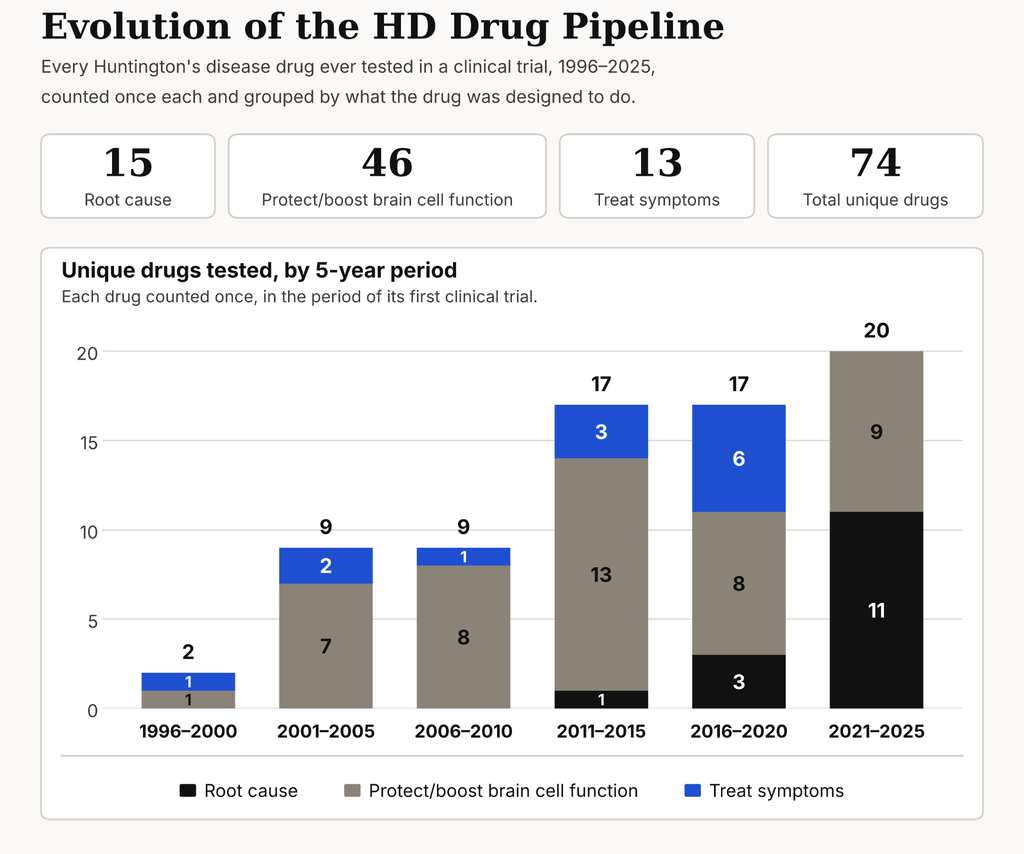
Grouped this way, most HD drugs fall into one of three buckets. Some are designed to treat specific symptoms, like the involuntary movements, sometimes called choreachorea Involuntary, irregular ‘fidgety’ movements that are common in HD. Others aim to protect or boost brain cell function more broadly, without targeting the disease’s underlying cause. And a growing number now go after the root cause of HD directly, either by lowering the levels of the expanded huntingtin proteinhuntingtin protein The protein produced by the HD gene. itself, or by slowing the process that causes the huntingtin gene to keep growing over a person’s lifetime, called somatic instabilitysomatic expansion A process in which the CAG repeat in the Huntingtin gene can change over a person’s lifetime in some cells of the body, particularly in the brain..
A recent study took a comprehensive look at HD trials over roughly the last decade, tallying up the sheer number of trials that have been conducted. The bottom line? HD trials have come a long way from the handful of studies running each year in the field’s early days. But a single drug can rack up several trials as it moves through different phases of testing, or gets tested again in a follow-up study. Here we’ll focus on the number of distinct drugs in play, rather than the number of trials, since that’s a good way to capture how many real options are out there for the HD community and how that landscape has evolved over the decades.
Setting the Stage for HD Therapies
The study we’re covering starts its count in 2014, but to really appreciate how far the field has come, it helps to rewind further, back to when HD trials were just getting started.
The HD gene itself was identified in 1993. The very first HD trials, testing drugs like riluzole and amantadine, began just a few years later, in the late 1990s. At that point, researchers didn’t yet have a specific molecular target to aim at, just a newly discovered gene and a lot of open questions about what it did. So it’s little surprise that these earliest trials were symptomatic by necessity: there wasn’t yet anything else to try.
Through the 2000s, a second bucket of drugs joined the pipeline: ones aimed at protecting or supporting brain cell function generally, rather than treating any one symptom. Creatine, coenzyme Q10, and minocycline are some of the names from this era, tested in the hope that bolstering brain cells’ energy reserves, shoring up energy production, or calming inflammationinflammation Activation of the immune system, thought to be involved in the HD disease process might slow HD down. By the early 2010s, this had become the biggest category in the pipeline by a wide margin, ahead of the symptomatic treatment approaches of the prior decade.
The 2000s also saw the tools of molecular biology mature in ways that would matter enormously for HD later on, even if the payoff wasn’t obvious yet. The cost of sequencing a genomegenome the name given to all the genes that contain the complete instructions for making a person or other organism began its now-famous freefall, from roughly $100 million to $1,000, making genetics fast and cheap enough to use not only for diagnosis, but also to guide drug design. And in 2006, the Nobel Prize was awarded for the discovery of RNA interferenceRNA interference A type of gene silencing treatment in which specially designed RNA molecules are used to switch off a gene, or RNAiRNA interference A type of gene silencing treatment in which specially designed RNA molecules are used to switch off a gene: a natural process cells use to silence specific genes. It’s the exact mechanism several future HTT-lowering drugs would come to rely on.
Heading into the mid-2010s, not a single HD clinical trialclinical trial Very carefully planned experiments designed to answer specific questions about how a drug affects human beings had yet tested a drug designed to lower huntingtin. That’s the baseline for the changes in HD drug development documented in this study.
The Tide Turns Toward the Root Cause
Somewhere in the mid-2010s, the baseline started to move. The first trial of the huntingtin-lowering drug tominersen was conducted by Ionis in 2015, but it wouldn’t be alone for long.
The study found that new drugs entering the HD pipeline have flipped from being mostly symptomatic in the mid-2010s, to being almost entirely disease-modifying by the early 2020s. That shift lines up with a broader moment across biology and medicine. In 2017 and 2019, the first gene therapies for other rare diseases won approval, such as Luxturna for inherited vision loss and Zolgensma for SMA. These use viral vectors to deliver working copies of genes directly into cells, the same underlying delivery approach HD gene therapies use today. HD’s own pipeline was catching a wave that was lifting rare disease research more broadly.

As time went on, we found ourselves with not only a new therapeutic approach, but several distinct technical strategies emerging side by side: antisense oligonucleotidesASOs A type of gene silencing treatment in which specially designed DNA molecules are used to switch off a gene that bind and degrade the huntingtin message, gene therapies that equip brain cells to lower huntingtin indefinitely, and splicingsplicing the cutting up of RNA messages, to remove non-coding regions and join together coding regions. modulators that interfere with how the huntingtin message gets processed before it’s turned into protein. Each represents a parallel bet on how best to get to the same target.
Symptomatic and brain-support drugs are still part of that pipeline too, and still matter a great deal to people living with HD. But it’s the diversification on the disease-modifying side that stands out: several independent approaches advancing at once, rather than the field’s hopes riding on any single drug or mechanism.
We know that this diversification reflects advances in understanding HD biology, paired with the broader maturing of genetic medicine as a technology. But why did the field move this way, and what does it say about the trials that came before it?
A Sturdier Foundation
The study offers a pointed explanation for why so many earlier HD drugs failed to pan out: they often had weaker mechanistic rationale to begin with. Many were repurposed compounds, drugs already in use for other conditions, tested in HD on the strength of a plausible mechanism rather than direct evidence. Promising in theory, but built on a foundation that was more speculative than solid.
What changed wasn’t researchers’ effort or ambition. It was the depth of what we actually knew about huntingtin itself. Decades of basic research mapped out the structure of the huntingtin proteinhuntingtin protein The protein produced by the HD gene., how mutant huntingtin behaves differently from the normal version, and the mechanisms by which it causes damage. That groundwork is what made it possible to design drugs aimed at huntingtin directly, rather than working around it.
Understanding a disease well enough to design a drug against it is one thing. Trusting that the underlying technology works safely in people is another. The genomegenome the name given to all the genes that contain the complete instructions for making a person or other organism sequencing and RNAiRNA interference A type of gene silencing treatment in which specially designed RNA molecules are used to switch off a gene advances of the 2000s had already put the tools for precise genetic medicine within reach. However, it took time, and accumulated trial data, for that category of drug to earn the confidence that shapes what studies get funded and greenlit. The COVID-19 pandemic accelerated that trust significantly. mRNAmessenger RNA A message molecule, based on DNA, used by cells as the final set of instructions for making a protein. vaccines reached hundreds of millions of people in a matter of months, and safely, giving regulators, investors, and drug developers alike a level of real-world confidence in nucleic acid medicines that would have taken years to build through smaller trials alone.

Put together, a clearer picture of the disease and a more capable set of tools changed what kind of drug was worth testing in the first place. The newest generation of HD trials is built on a sturdier foundation than what came before.
Every Trial Gets Us Closer
Of course, a sturdier foundation is not the same as a guaranteed one. The study found that HD drug trials have had one of the lowest overall success rates among the diseases it compared, lower than Alzheimer’s, Parkinson’s, and ALS, with the odds worsening as drugs move from mid-stage trials into large final-stage studies, and from those trials into approval. This low success rate traces back to the fact that early trials were guided by borrowed rationale rather than HD-specific biology. Only two drugs have reached approval for HD in the past decade, deutetrabenazine and valbenazine, both aimed at treating movement symptoms. Neither slows the disease itself, and no huntingtin-lowering or other disease-modifying therapy has yet been approved.
Tominersen’s history captures both the hope and the difficulty of this era. When it entered its first large trial in 2019, it was the field’s biggest test yet of whether lowering huntingtin could help people with HD. That trial was halted in 2021, after it became clear the drug wasn’t producing a real clinical benefit – even though it was successfully lowering huntingtin in the body. This was an early sign that biology behaving as expected doesn’t guarantee that people will feel or function better. Roche continued working with the drug in smaller, earlier-stage trials afterward, but announced this year that it was ending the tominersen program for good, along with a related huntingtin-lowering drug, RG6496. Though disappointing, the tominersen trials answered questions that matter for every huntingtin-lowering drug to follow: that huntingtin can be lowered safely in people, that doing so moves measurable biomarkers, and that biomarkerbiomarker a test of any kind – including blood tests, thinking tests and brain scans – that can measure or predict the progression of a disease like HD. Biomarkers may make clinical trials of new drugs quicker and more reliable. movement alone may not be enough to prove a clinical benefit. What’s left is a sharper set of questions about dose, timing, and how well a drug reaches the brain regions most affected by HD; questions driving the next generation of trial design.
The study we’re covering was first published online on June 1, 2026, and mentioned uniQure’s AMT-130 gene therapy, noting that the FDA had judged the therapy’s existing data insufficient, which added to uncertainty among drug developers about what evidence the agency will accept. Things have moved quickly since then! uniQure has since filed for approval in the US and the UK and shared their four-year follow-up data and a timeline for a decision from the FDA. Between Roche ending its program and uniQure seeking approval, the story of huntingtin lowering is far from over.
Building Better Trials
The authors of the study made an important observation: no HD trial in their dataset was discontinued for lack of volunteers. This is a testament to the dedication and engagement of the HD community. A large part of the credit goes to Enroll-HD, the world’s largest HD research platform, which has spent over a decade building a global, engaged community of participants ready to take part in studies as they come along.
Trial design itself has also had to mature. Early HD symptoms can be subtle, easy to miss on a single clinical exam, which makes it hard to know exactly who belongs in a trial and at what point in the disease. The 2022 introduction of the HD Integrated Staging System (HD-ISS) provides researchers with a shared framework for describing where someone is in the course of HD, from the earliest biological changes through to diagnosis and beyond, making it easier to enroll the right participants at the right time.
One challenge remains open: agreeing on what to actually measure. Biomarkers and clinical scales each capture a different piece of the picture, and, as tominersen’s trial showed, they don’t always change at the same rate. Sharpening these tools, especially for people in the earliest stages of HD, where change is hardest to detect, remains a key priority as the field moves forward .
The Road Ahead
The study also reported that the vast majority of HD trials are run in North America and Europe, with very few in South America, a gap that is hard to overlook. Families in this region have shaped HD research from the start, including the Venezuelan families whose participation helped researchers find the HD gene, and HD is more common in parts of Venezuela, Colombia, Peru, and Brazil than elsewhere. The study points to practical barriers such as limited access to genetic testing, a shortage of movement disorder specialists, and regulatory hurdles. These sit within a wider picture of how geography and resources shape access to care for HD and well beyond it.
They also note that getting an HD drug through all three phases of testing takes close to a decade on average, and gene and cell therapies tend to spend even longer under investigation, in part because regulators require years of follow-up to be confident these treatments are safe.
These caveats certainly haven’t slowed the pace of new announcements. New agents keep entering the pipeline, including the field’s first steps towards trials targeting somatic instability. Huntingtin lowering, somatic instabilitysomatic expansion A process in which the CAG repeat in the Huntingtin gene can change over a person’s lifetime in some cells of the body, particularly in the brain., and the targets that will follow all trace back to the same shift: drugs built on real HD biology instead of borrowed guesses. It’s the sturdiest ground HD research has stood on to date, and the building is still underway.
Keeping Up With HD Clinical Trials
With so many potential treatments now being tested, keeping track of what’s happening can feel like a full-time job! Fortunately, there are some excellent resources to help HD families navigate the changing clinical trialclinical trial Very carefully planned experiments designed to answer specific questions about how a drug affects human beings landscape.
Here at HDBuzz, our HD Clinical Trial Tracker, found on our homepage, brings together information about drugs being tested for HD, what they’re designed to do, and how far they’ve progressed through clinical testing. We only include companies actively running trials in our tracker but you an find information on past studies in our back catalogue of articles
Many regional HD organisations have resources on local trials happening in their different geographies. For example, the Huntington’s Disease Society of America (HDSA) maintains a research pipeline overview, while its HD Trialfinder helps people in the US and Canada find studies that may be recruiting participants. This includes drug trials as well as observationalobservational A study in which measurements are made in human volunteers but no experimental drug or treatment is given studies and other research opportunities. Families can browse studies or use the matching service to explore opportunities that might be suitable for them.
These resources are a good place to start, whether you’re following the latest developments or considering taking part in research yourself.
Summary:
- HD drug development has shifted toward treatments targeting the disease’s underlying biology, including huntingtin lowering and somatic instabilitysomatic expansion A process in which the CAG repeat in the Huntingtin gene can change over a person’s lifetime in some cells of the body, particularly in the brain..
- Several distinct approaches are advancing in parallel, supported by decades of basic research and advances in genetic medicine.
- Trial setbacks have highlighted that lowering huntingtin or changing biomarkers does not necessarily translate into clinical benefit.
- Dedicated volunteers, Enroll-HD, and improved disease staging have strengthened the foundations for clinical trials.
- Major challenges remain, including measuring treatment effects, lengthy development timelines, and unequal access to trials across regions.
- The expanding pipeline offers reasons for hope, while disease-modifying treatments still need to demonstrate their benefits.
For more information about our disclosure policy see our FAQ…