Sealing the gap: a case for slower, smarter DNA repair
6 min read
Your body assembles DNA like a team of workers who set and bond a pattern of tiles. A recent study shows that one special assistant might slow somatic CAG expansion and delaying HD onset.
When your body makes new DNA, or fixes damaged DNA, it is assisted by a special protein called LIG1. If laying down DNA is like arranging a pattern of tiles, then LIG1 is the assistant who checks over the tiles and seals up the space between them. Some people with Huntington’s disease (HD) have an alternate version of LIG1, called LIG1 K845N, that can delay how early they develop symptoms of HD. A group of scientists now report what this alternative version of LIG1 might be doing to delay HD, and whether it could point the way to effective treatments.
Setting tiles and sealing the gaps
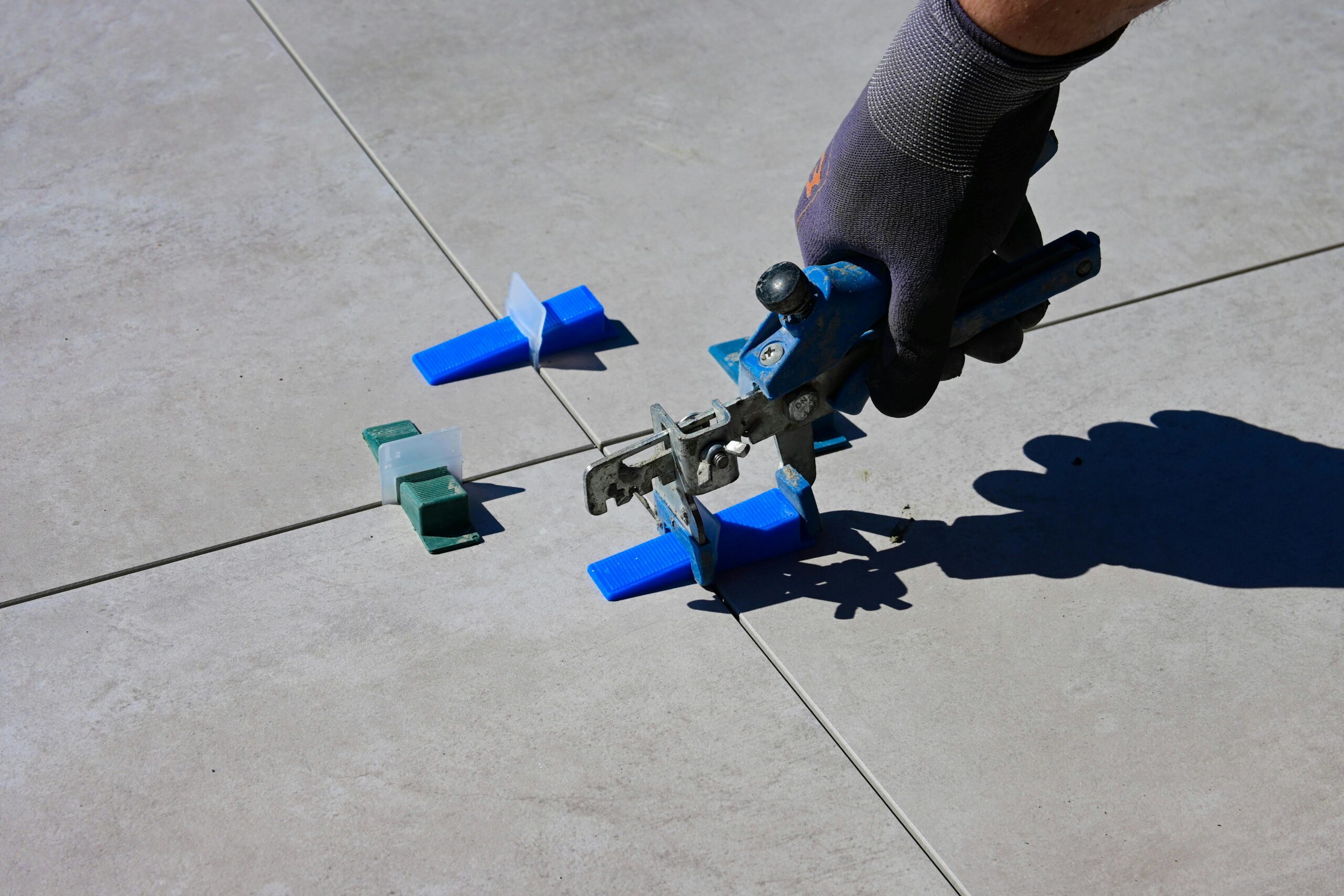
If you’ve ever seen a home renovation, you know that setting a pattern of tiles can be one of the most precise and demanding jobs. Tiles have to be perfectly arranged so they follow the intended pattern, and also carefully spaced so that gaps between the arranged tiles can be sealed evenly.
When your body makes new DNA, or fixes damaged DNA, it lays down a pattern of special chemical tiles called nucleotides (A, G, C, or T) and then seals them together with a chemical bond.
In people with HD, a series of three DNA tiles (CAG) repeat over and over, 40 or more times in a row.
A tiling assistant that delays HD
The protein that arranges the pattern of new DNA tiles in your body is called a polymerase. The assistant that checks the DNA tile pattern and bonds the tiles together is called a ligase. There are many polymerases and ligases that work together to make sure the A, T, G, and C nucleotide tiles are correctly assembled and bonded together. This study focused on one assistant called LIG1.
What does LIG1 have to do with HD? Well, in some people there is an alternative version of LIG1, sort of like an alternate tiling assistant that substitutes in to do the job. This alternate LIG1 has a specific change, making it perform the work in a slightly different way, like an assistant who uses a different grouting tool.
That change is called K845N. It might sound like the name of a Star Wars droid, but really it gives scientists the genetic coordinates of the change – at the 845th position, a K protein building block (lysine) is substituted with an N protein building block (asparagine).
Remarkably, people with HD who have LIG1 with K845N develop symptoms of HD much later than expected, up to 7-8 years on average. Scientists who study HD are very interested in how this alternate LIG1 K845N causes such a profound change in people with HD, and whether it could help them to find ways of slowing the disease.

Bimbim Sindu
Face off: comparing how regular LIG1 and substitute LIG1 do their jobs
People in the same job sometimes perform their work in slightly different ways. Think of a waiter who carries plates to a table with their right hand, as compared to another waiter who holds the plates in a different way with their left. Typically this does not impact the end result (diners receiving their food), but occasionally it might (maybe one way of holding plates is less likely to fall when the waiter is bumped).
In the case of LIG1 and LIG1 K845N, there is something about how these two assistants check and bond DNA tiles differently that changes the timing of HD symptoms.
One assistant is slower and more careful
Polymerases (the tile setters) working ahead of ligases (the bonding assistants) sometimes put down the wrong tile, and LIG1 can sometimes catch this mistake.
A group of scientists designed clever experiments to test whether regular LIG1 and LIG1 K845N respond differently when confronted with DNA tiles that have been placed correctly and incorrectly. The researchers first tested how efficiently the two different LIG1 versions bind tiles that match correctly. Interestingly, they found that LIG1 K845N works more slowly. Maybe that’s why LIG1 K845N is not the usual guy on the job – regular LIG1 is faster!
But things got interesting when the scientists presented regular LIG1 and LIG1 K845N with DNA tiles that were mismatched. The scientists did this deliberately, but polymerases that set up the DNA tiles sometimes make this mistake when they arrange new DNA tiles for LIG1 to check and bond.
Which LIG1 did a better job of catching the mistake? Regular LIG1 usually went ahead and bonded the wrong tiles together anyway, but LIG1 K845N usually stopped rather than bond the incorrect tile. So LIG1 K845N works slower, but seems to check more carefully that the DNA tiles match.

LIG1 K845N might slow somatic expansionsomatic expansion A process in which the CAG repeat in the Huntingtin gene can change over a person’s lifetime in some cells of the body, particularly in the brain. of the CAG repeatCAG repeat The stretch of DNA at the beginning of the HD gene, which contains the sequence CAG repeated many times, and is abnormally long in people who will develop HD
The scientists who performed this study aren’t yet certain how this difference between LIG1 (fast but sloppy) and LIG1 K845N (slow but careful) acts to delay HD in people. But research has shown that other related proteins called mismatch repair proteins can increase the number of repeated CAG tiles in the brain, through a process called somatic expansionsomatic expansion A process in which the CAG repeat in the Huntingtin gene can change over a person’s lifetime in some cells of the body, particularly in the brain..
Could LIG1 K845N somehow change the way that repeating CAG tiles get longer? Maybe that’s how LIG1 K845N delays HD in people.
To answer this, the researchers studied HD mice with very long CAG repeats. These mice also show somatic expansionsomatic expansion A process in which the CAG repeat in the Huntingtin gene can change over a person’s lifetime in some cells of the body, particularly in the brain., meaning the repeating CAG tiles get longer and longer in some cells of their brains with time. The researchers then used some amazing new tools you may have heard about (CRISPRCRISPR A system for editing DNA in precise ways technology) to add human LIG1 K845N into these HD mice and test the effect on somaticsomatic relating to the body CAG expansion.
Remarkably, the HD mice with LIG1 K845N had less somaticsomatic relating to the body CAG expansion than HD mice with regular LIG1, meaning that the CAG tiles increased in number more slowly.
This matches what the scientists expected given that LIG1 K845N slows symptoms of HD in people. It also suggests that the special way that LIG1 K845N checks over and seals up DNA tiles also somehow reduces somaticsomatic relating to the body CAG expansion.
More work to be done
An important caveat is that these experiments were performed in cells or mice engineered for studying HD. The scientists did not directly test the effect of LIG1 K845N in people.
But their results suggest that the way LIG1 checks and bonds DNA tiles somehow slows down somaticsomatic relating to the body CAG expansion in people. This study adds to mounting evidence that somaticsomatic relating to the body CAG expansion might be an important step in how people develop HD – and that slowing it might help slow the disease.
This is more good news for the development of drugs that target somatic expansionsomatic expansion A process in which the CAG repeat in the Huntingtin gene can change over a person’s lifetime in some cells of the body, particularly in the brain. in people with HD.
Summary
- Your body assembles DNA with a team of tile-setters (polymerases) and assistants (ligases) who check and bond DNA tiles together.
- A special ligase in some people, called LIG1 K845N, slows the development of HD.
- LIG1 K845N bonds DNA tiles more slowly but checks tile accuracy more carefully.
- LIG1 K845N may slow HD by reducing somatic expansionsomatic expansion A process in which the CAG repeat in the Huntingtin gene can change over a person’s lifetime in some cells of the body, particularly in the brain. of the CAG repeatCAG repeat The stretch of DNA at the beginning of the HD gene, which contains the sequence CAG repeated many times, and is abnormally long in people who will develop HD.
For more information about our disclosure policy see our FAQ…