
First participant dosed in the PRECISE-HD trial of pridopidine
4 min read
The first participant has now been dosed in the Phase 3 PRECISE-HD trial of pridopidine for HD. The study will test whether the drug can slow disease progression in people most likely to benefit

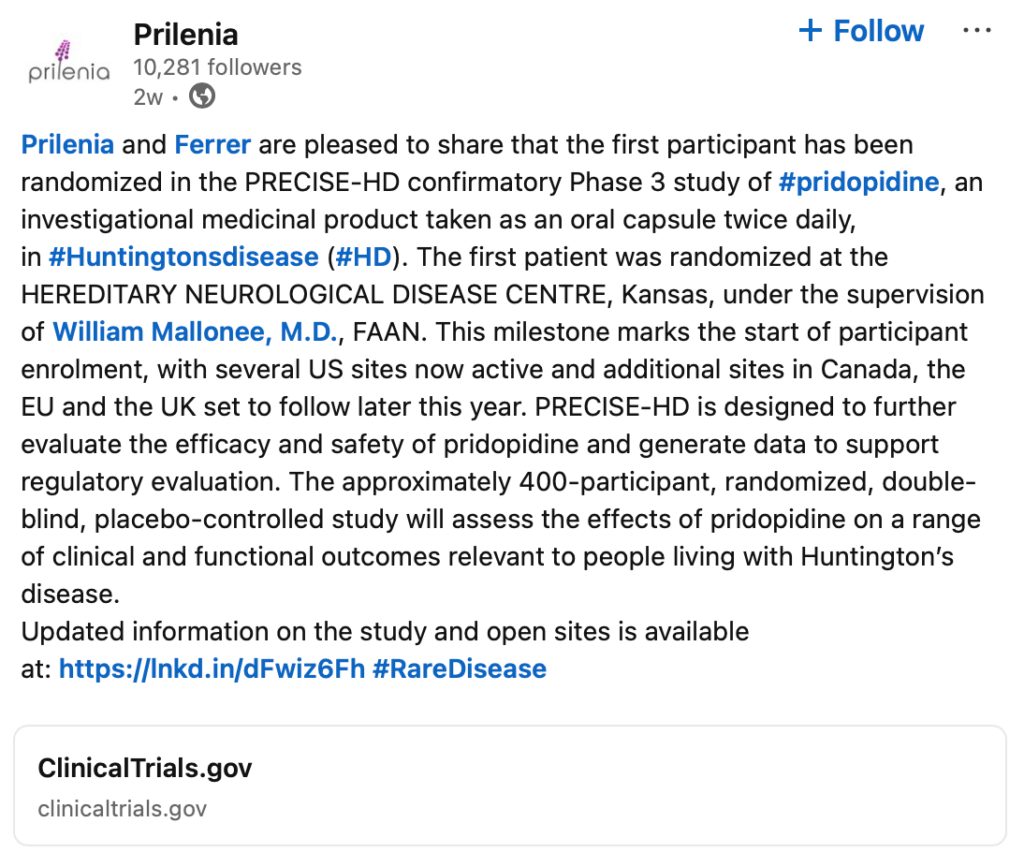
A new Huntington’s disease (HD) clinical trialclinical trial Very carefully planned experiments designed to answer specific questions about how a drug affects human beings has officially begun, marking another important step in the search for treatments that could slow the progression of the disease. Prilenia Therapeuticstherapeutics treatments and Ferrer have announced via a Linkedin post that the first participant has been dosed in the PRECISE-HD Phase 3 clinical trialclinical trial Very carefully planned experiments designed to answer specific questions about how a drug affects human beings, which is testing the investigational drug pridopidine.
Another chance for pridopidine
Long-time HDBuzz readers may recognise pridopidine. Pridopidine has had one of the longest and most winding development journeys of any experimental HD therapy. Originally developed as a treatment for movement symptoms, early clinical trials failed to meet their primary goals despite nuanced hints of benefit on some tests.
In 2023, the large Phase 3 PROOF-HD study did not meet its primary goal of slowing disease progression across all participants. However, a planned analysis of the data suggested that people who were not taking antidopaminergic medications (ADMs) appeared to have greater benefit from pridopidine than those who were taking these medications. ADMs are drugs commonly prescribed to treat choreachorea Involuntary, irregular ‘fidgety’ movements that are common in HD or psychiatric symptoms.
Those findings prompted discussions with regulators and the HD community about how best to determine whether this apparent benefit was real. What emerged is PRECISE-HD: a new confirmatory trial specifically designed to test that hypothesis.
What is PRECISE-HD?
PRECISE-HD is a global Phase 3 study that plans to enroll approximately 400 people aged 23-65 with early- to mid-stage HD across up to 75 clinical sites in North America and Europe.

Participants will be randomly assigned to receive either pridopidine or placeboplacebo A placebo is a dummy medicine containing no active ingredients. The placebo effect is a psychological effect that causes people to feel better even if they’re taking a pill that doesn’t work., in two groups. For the first two weeks they will take one capsule by mouth every morning, then morning and afternoon, for one year. Over the course of the year, participants will visit the clinic 6 times, and they will have 5 safety checks over the phone. This is a double-blind study, meaning neither participants nor researchers know who is receiving which treatment during that period. Those who complete this stage will then have the opportunity to continue into a two-year study known as an open-label extension, where everyone receives pridopidine.
To better evaluate the subgroup that previously appeared to benefit, the study will enroll people who have not recently been treated with antidopaminergic medications.
Researchers will measure whether pridopidine affects several aspects of HD, including overall disease progression (using the composite Unified Huntington’s Disease Rating Scale, or cUHDRS), day-to-day functioning, movement symptoms, thinking and cognition, speech and quality of life.
How might pridopidine work?
Unlike huntingtin-lowering therapies, pridopidine does not target the huntingtin gene or protein directly. Instead, it targets a protein called the sigma-1 receptorReceptor a molecule on the surface of a cell that signalling chemicals attach to, which is thought to help nerve cells cope with stress and to support several pathways involved in maintaining healthy brain function. Laboratory studies suggest this signalling may promote nerve cell survival and resilience, although whether this translates into slowing HD progression in people remains to be proven.
Why does the first participant matter?
The first participant being dosed is an important operational milestone. It means the trial has moved beyond planning and regulatory green-light and has entered the stage where participants are actively receiving treatment.
However, it does not tell us anything yet about whether the drug works. Clinical trials of this size require many participants and lengthy follow-up before researchers can determine whether any differences emerge between the treatment and placeboplacebo A placebo is a dummy medicine containing no active ingredients. The placebo effect is a psychological effect that causes people to feel better even if they’re taking a pill that doesn’t work. groups. As always, it will be important to wait for the full trial results before drawing conclusions.
Looking ahead
PRECISE-HD is designed to answer a very specific question: can the encouraging signals seen previously in a carefully selected group of participants be confirmed in a rigorous, well-powered clinical trialclinical trial Very carefully planned experiments designed to answer specific questions about how a drug affects human beings?
If successful, the study could provide the evidence needed to support another regulatory review of pridopidine. If not, it will still provide valuable information that helps the HD field better understand which therapeutic approaches are, and are not, likely to benefit people living with Huntington’s disease.
For now, the dosing of the first participant represents another encouraging sign that the HD clinical trialclinical trial Very carefully planned experiments designed to answer specific questions about how a drug affects human beings pipeline continues to move forward. Every new study brings the field closer to understanding which treatments have the potential to make a meaningful difference for families affected by Huntington’s disease.
Summary:
- The first participant has now been dosed in the global Phase 3 PRECISE-HD trial of pridopidine.
- The study will enrol around 400 people with early- to mid-stage HD who have not recently taken antidopaminergic medications.
- PRECISE-HD follows earlier findings suggesting this subgroup may benefit more from pridopidine than the broader HD population.
- The trial is designed to determine whether pridopidine can slow HD progression, but it is far too early to know whether the drug will be successful.
- More information on this trial can be found on Prilenia’s website and ClinicalTrials.gov
For more information about our disclosure policy see our FAQ…