
Huntington’s Disease Therapeutics Conference 2026 – Day 2
⏱️ 18 min read | HDBuzz is back with Day 2 of the 21st annual CHDI HD Therapeutics Conference in Palm Springs, CA. We heard about new techniques to zoom in on HD biology in extraordinary detail.


Greetings from Day 2 of the CHDI HD Therapeuticstherapeutics treatments Conference! HDBuzz continues to provide summaries of the exciting talks from HD scientists gathered in Palm Springs from around the world. This day’s sessions were focussed on research seeking to understand what is driving Huntington’s disease (HD), using new tools and technologies to explore the detailed molecular changes that happen throughout the course of HD. These speakers discussed new ways of looking at lots of data, and methodologies allowing us to dive deeper into genetics and biology.

Unpicking the biology of HD
Nat Heintz – how epigenetics controls genetic on/off switches and somatic expansionsomatic expansion A process in which the CAG repeat in the Huntingtin gene can change over a person’s lifetime in some cells of the body, particularly in the brain.
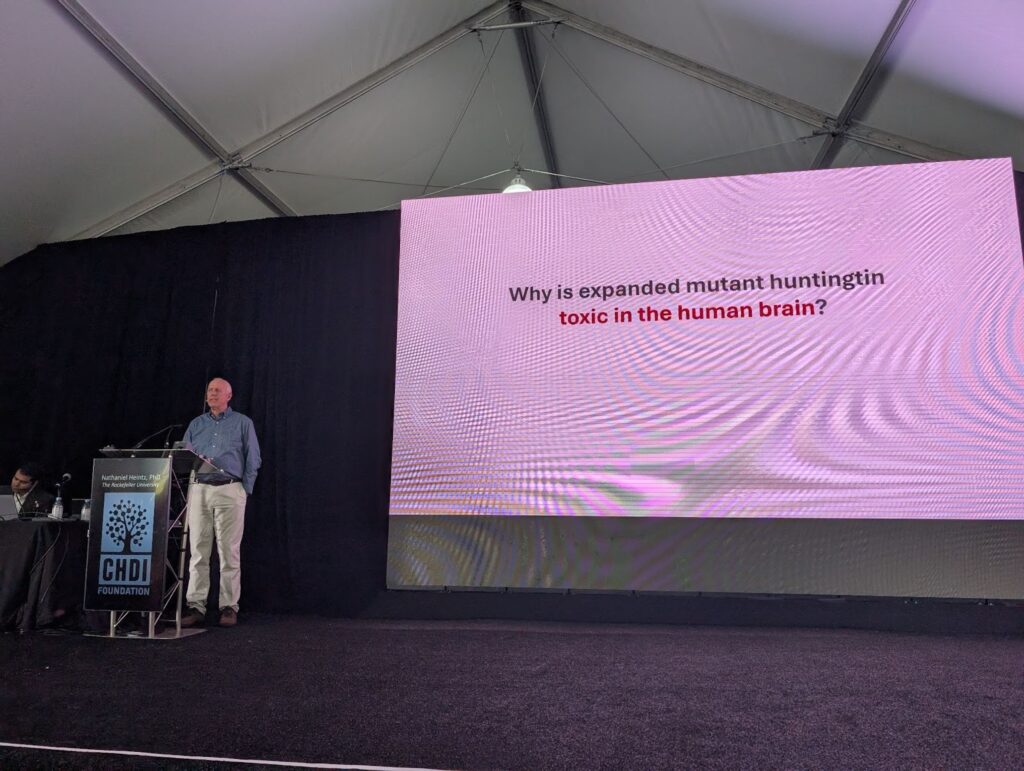
Up first was Nat Heintz from Rockefeller University in New York. His research team has been focussed on understanding the details of somatic expansionsomatic expansion A process in which the CAG repeat in the Huntingtin gene can change over a person’s lifetime in some cells of the body, particularly in the brain., the process by which the CAG number in the HTTHTT one abbreviation for the gene that causes Huntington’s disease. The same gene is also called HD and IT-15 gene gets longer in some cell types as people with HD age.
Nat’s team studies the brains of people who have passed from HD. Previously, his team has presented data showing somaticsomatic relating to the body expansions specifically in cells that get sick. What’s curious though is that they also see expansions in other cells that stay relatively healthy.
This is puzzling as it suggests somatic expansionsomatic expansion A process in which the CAG repeat in the Huntingtin gene can change over a person’s lifetime in some cells of the body, particularly in the brain. might not be the main reason that cells get sick in HD. Biology is complicated so our simple models of how things work don’t always hold true when we dig into data from real people with HD.
Now his team is studying how epigenetics might influence somatic expansionsomatic expansion A process in which the CAG repeat in the Huntingtin gene can change over a person’s lifetime in some cells of the body, particularly in the brain.. Epigenetics is a bit like the control room for our genetic material, helping influence which genes are switched on and off, in which cells, at which timepoints, and under different conditions or stresses.
One observation they have made is that the DNA repair machine, MutSBeta(β), which we heard about in the afternoon of Day 1, seems to be found at higher levels in cell types which have more somatic expansionsomatic expansion A process in which the CAG repeat in the Huntingtin gene can change over a person’s lifetime in some cells of the body, particularly in the brain., regardless of whether or not the cells die because of HD.
Nat’s team are now looking into other genes whose on-off switches change with different levels of somatic expansionsomatic expansion A process in which the CAG repeat in the Huntingtin gene can change over a person’s lifetime in some cells of the body, particularly in the brain.. This might help identify genes that drive somatic expansionsomatic expansion A process in which the CAG repeat in the Huntingtin gene can change over a person’s lifetime in some cells of the body, particularly in the brain., and could explain why some cells get sick whilst others fare better.
Epigeneticepigenetic Referring to changes in gene activity caused by chemical tags on DNA or its packaging, without altering the DNA sequence—these changes can affect how cells read and use genes. control of which genes are switched on or off can happen through chemical decorations of the DNA itself. These decorations can also occur on histoneshistone special proteins that our DNA wraps around to stabilize and protect it, proteins which act like sewing bobbins, wrapping up our DNA in the nucleusnucleus A part of the cell containing genes (DNA) to keep it safe and compact. Nat’s team are mapping out these chemical modifications in different HD systems.
Understanding how these genes are turned on or off can give us clues about how to intentionally control them. The hope is that we could turn off the genes that cause harmful somatic expansionsomatic expansion A process in which the CAG repeat in the Huntingtin gene can change over a person’s lifetime in some cells of the body, particularly in the brain., or turn on the genes that prevent it.
Another key focus for Nat’s team is understanding why the expanded HTTHTT one abbreviation for the gene that causes Huntington’s disease. The same gene is also called HD and IT-15 protein is toxic in some parts of the brain, but not so much for other tissues or organs. A person carrying the gene for HD will make expanded HTTHTT one abbreviation for the gene that causes Huntington’s disease. The same gene is also called HD and IT-15 in every cell of their body throughout their whole life, so why does this affect the brain so much, and typically only in later life?
It turns out that some of the switches that turn genes on or off are themselves controlled differently in cells containing the expanded HTTHTT one abbreviation for the gene that causes Huntington’s disease. The same gene is also called HD and IT-15 gene. The team thinks this is caused by different chemical decorations on the DNA that they have observed.
There are all types of cool computer analyses which can really dive into these super rich datasets to provide new insight into these drivers of HD. Nat highlights work from the Cristea lab at Princeton showing that HTTHTT one abbreviation for the gene that causes Huntington’s disease. The same gene is also called HD and IT-15 itself hangs out with proteins which might influence the processes that regulate gene levels.
One driver of this process is MED15, a protein encoded by a gene previously shown to influence the timing of HD symptoms appearing. At the same time, changes in the DNA chemical decorations seem to be having a big effect.
Because he’s seeing changes to DNA chemical modifications in specific cells, especially the most vulnerable ones, Nat proposes these ideas as a new model for how HD might be driven.
These detailed molecular insights into what might be driving HD in people are only possible because of the generous and selfless donations of brains from people who have passed. These are invaluable resources for researchers, like Nat, to really unpick exactly how HD might be working.
Steve McCarroll – a ticking DNA clock
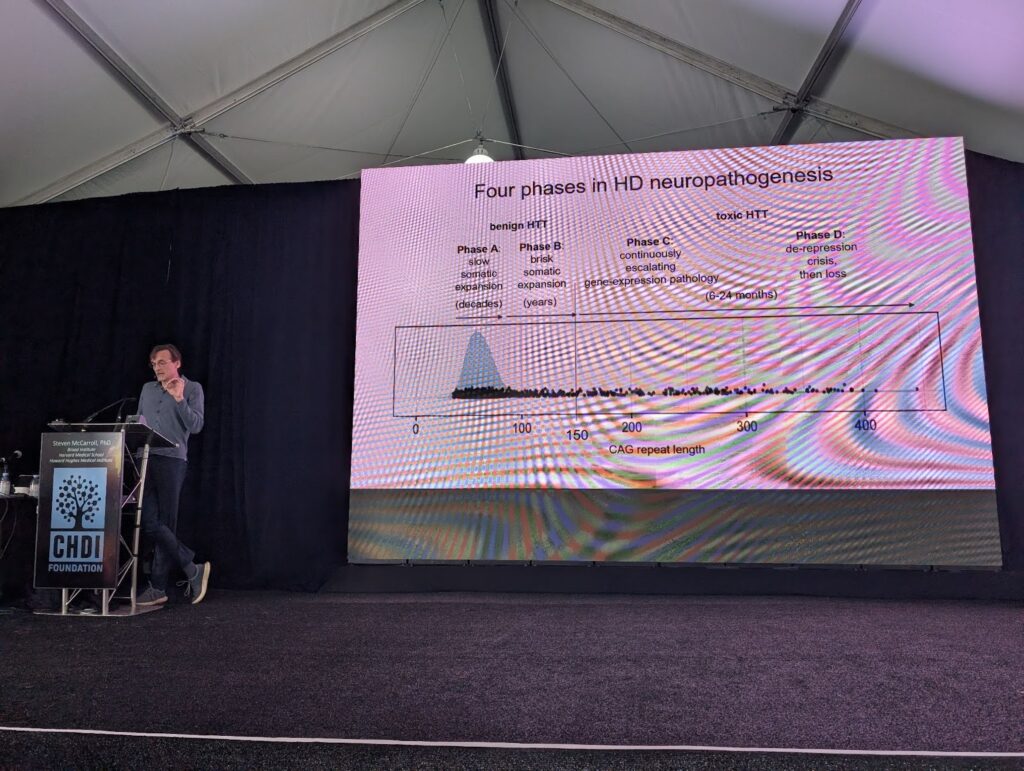
Next up is Steve McCarroll from Harvard Medical School. Steve’s team is also interested in understanding somatic expansionsomatic expansion A process in which the CAG repeat in the Huntingtin gene can change over a person’s lifetime in some cells of the body, particularly in the brain. in human HD brain tissue. They are looking to figure out the “trigger” that could lead to the cascade of harmful downstream events which ultimately cause loss of neuronsneuron Brain cells that store and transmit information.
Steve explains how they looked at the CAG length in individual cells from donor brains, and found that changes in which genes are turned on or off get extreme once the CAGs expand beyond a certain length.
Steve previously proposed a threshold of 150 CAGs for when things really seem to fall off and stop working well in brain cells with HD. They call this the “ticking DNA clock” model, which was quite controversial when first proposed at this meeting 3 years ago!
The proposal of controversial ideas or models is actually an important part of the scientific process and we are lucky to have super smart folks with varied opinions working on solving HD research challenges. Scientists love discussion and disagreement – it’s how we get to consensus!
In this model, Steve’s team defines different phases of HD which they think best explain the data and observations they have made from studying HD brains. They think expansions start slowly at first, and rapidly increase as more CAG repeats are added.
These models and timelines can help scientists map theories about the progression of HD. This can help inform future clinical decisions about which interventions might work best at which timepoint.
Although the striatum (in the center of the brain) is the region most affected in HD, another region called the cortex (the outer wrinkly bit) is also affected. Steve’s team is asking whether somatic expansionsomatic expansion A process in which the CAG repeat in the Huntingtin gene can change over a person’s lifetime in some cells of the body, particularly in the brain. has the same effects in different brain areas.
Steve’s team dives in at a granular level, not just asking questions about location, but also exactly which types of cells are affected – they have collected SO MUCH DATA! He can see that different cells seem to have very different journeys through HD, and have different degrees of somatic expansionsomatic expansion A process in which the CAG repeat in the Huntingtin gene can change over a person’s lifetime in some cells of the body, particularly in the brain..
Their model built on all this data suggests that neuronsneuron Brain cells that store and transmit information first experience very slow expansion, followed by acceleration, and then things start to go wrong for these neuronsneuron Brain cells that store and transmit information. After entering this toxic phase, somatic expansionsomatic expansion A process in which the CAG repeat in the Huntingtin gene can change over a person’s lifetime in some cells of the body, particularly in the brain. can then hyper-accelerate.
At this stage, the cells get super sick because genes that should be turned on are off, and those that should be off are on. This causes the cells to lose their “identity,” the genes that make them their unique cell type. When those massive changes occur, the cells can’t survive.
However, there are some issues with this model though. One is that folks with a rare form of the HTTHTT one abbreviation for the gene that causes Huntington’s disease. The same gene is also called HD and IT-15 gene, where the DNA letter code is missing an interruption in the repeat, have onset of symptoms up to 10 years earlier than would be predicted.
Steve’s team wondered if perhaps the toxicity might happen earlier in folks with this type of HTTHTT one abbreviation for the gene that causes Huntington’s disease. The same gene is also called HD and IT-15 gene. Or perhaps gene switches are differently turned on or off, or maybe somatic expansionsomatic expansion A process in which the CAG repeat in the Huntingtin gene can change over a person’s lifetime in some cells of the body, particularly in the brain. doesn’t follow the same path. But they couldn’t find much to make sense of the data.
The massive amount of data is allowing them to follow up on other findings and questions, like how the CAG repeatCAG repeat The stretch of DNA at the beginning of the HD gene, which contains the sequence CAG repeated many times, and is abnormally long in people who will develop HD partners with other stretches of DNA within the HTTHTT one abbreviation for the gene that causes Huntington’s disease. The same gene is also called HD and IT-15 gene. These types of large datasets from people who had HD are invaluable for generating ideas that bring us closer to therapeuticstherapeutics treatments.
Bogdan Bintu – powerful microscopy for visualizing genetic on-off switches
The final talk of the morning was from Bogdan Bintu from the University of California San Diego. Bogdan started by telling the audience how much he loves building microscopes!
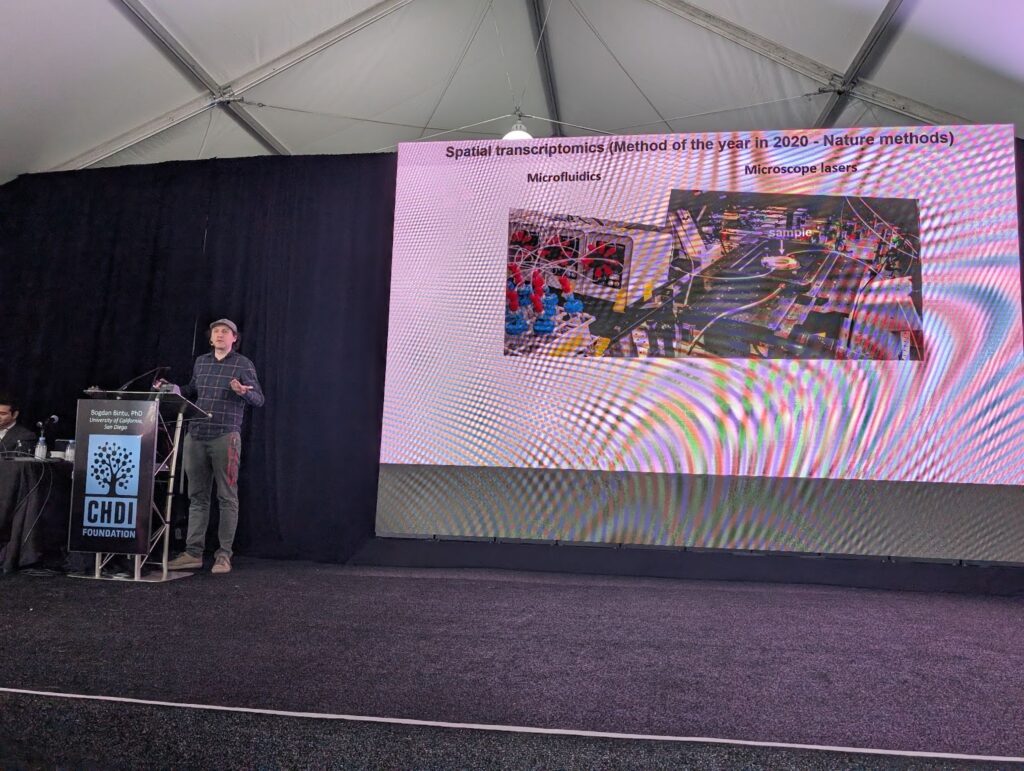
His scopes allow scientists to see exactly which genes are switched on in specific cells, by observing slices of the brain. This is called spatial transcriptomics, a fancy term for making a visual map of the transcriptome (the entire contents of genes that get made into RNARNA the chemical, similar to DNA, that makes up the ‘message’ molecules that cells use as working copies of genes, when manufacturing proteins. messages).
Most of the time, data about the brain comes from cells which have been broken apart and dissociated from the tissue structures they form. Bogdan can instead preserve the brain structures and see exactly where everything is happening in different layers while collecting much richer data sets with more information and detail.
Using the custom microscopes that he builds, Bogdan can study how the HTTHTT one abbreviation for the gene that causes Huntington’s disease. The same gene is also called HD and IT-15 protein forms toxic clumps in the brain, and overlay that with details about somatic expansionsomatic expansion A process in which the CAG repeat in the Huntingtin gene can change over a person’s lifetime in some cells of the body, particularly in the brain. and which genes are switched on and off, all laid onto a detailed map.
Bogdan’s team can use this information to find out which cells are lost in the HD brain compared to brains donated from people without HD. Bogdan and his team can use their platform to really dive into exactly which cell types and brain layers are most affected – very cool!
Next they looked to try and figure out why some cells are affected while others aren’t. Could this have to do with levels of the HTTHTT one abbreviation for the gene that causes Huntington’s disease. The same gene is also called HD and IT-15 gene itself? Although that would have made perfect sense, biology is rarely that simple. Sick cells did not track with either the levels of huntingtin, or the amount of toxic HTTHTT one abbreviation for the gene that causes Huntington’s disease. The same gene is also called HD and IT-15 protein clumps.
Bogdan’s team have figured out a way to approximate the CAG number of the HTTHTT one abbreviation for the gene that causes Huntington’s disease. The same gene is also called HD and IT-15 gene in single cells and map this back to each cell’s location in the brain – woah! This allows them to match somatic expansionsomatic expansion A process in which the CAG repeat in the Huntingtin gene can change over a person’s lifetime in some cells of the body, particularly in the brain. within single cells, tracking which cells expand and exactly where they are in the brain.
They found that the bigger CAG expansions are found in the sickest HD brain cells. These big expansions also tracked with more HTTHTT one abbreviation for the gene that causes Huntington’s disease. The same gene is also called HD and IT-15 protein clumps in the cells. Contrary to this though, the cells with the most extreme expansions seemed to have reduced levels of clumps. While a bit confusing, this seems to point to a key role for CAG expansions in brain cell health.
Bogdan is also interested in how manipulating the DNA repair machinery might help or hinder brain cells in HD. There are lots of companies looking to target DNA repair, so figuring out ahead of time how this might impact the brain with a fine-grain microscopy approach would be very helpful.
Carlos Sune – regulating genes with TCERG1
Carlos Sune’s lab is based at the Spanish National Research Centre. He is studying genetic modifiers of HD – genetic letter changes in the genomegenome the name given to all the genes that contain the complete instructions for making a person or other organism which can influence when signs and symptoms of HD begin.
One of these modifiers is called TCERG1. This protein is made up of lots of different modules that allow it perform its job in the cell – helping switch the right genes on and off, and processing genetic message molecules.
The HD field has known about TCERG1 and its role in HD for a long time, with studies published 25 years ago showing a link. More recently, genome-wide association study (GWAS) data solidified this link. GWAS studies look at genetic information from thousands of people with HD.
Intriguingly, the TCERG1 gene itself has a repeat stretch, and longer repeats are associated with earlier onset of symptoms in HD. An interesting coincidence, or a driving factor behind the link between HTTHTT one abbreviation for the gene that causes Huntington’s disease. The same gene is also called HD and IT-15 and TCERG1? Carlos is keen to find out!
TCERG1 can be mapped to the nucleusnucleus A part of the cell containing genes (DNA), where all the genetic material in the cell is organised. In fact, it can be found at one of the “liquid-y state” (aka phase separated) structures we talked about yesterday.
In this liquid-y mixture, TCERG1 works with other molecular machines in the cell to get specific genes switched on and processed correctly. Carlos is studying how these different jobs are performed in the cell and coordinated by TCERG1.
TCERG1 is particularly important for regulating genes with major roles in neuronsneuron Brain cells that store and transmit information, helping to organise their shape and the structures that allow them to form connections with other neuronsneuron Brain cells that store and transmit information.
Carlos is also mapping exactly which type of liquid-y structures TCERG1 is found in. This matters because different liquid-y compartments do different jobs in the cell. They are also mapping which molecular friends TCERG1 is hanging out with, and visualizing the structures where they congregate.
Zooming in on genetic regulators like TCERG1 is a way to better understand widespread HD-related changes in cells, potentially opening up new therapeutic paths to repair or reverse harmful disease states.
Gene Yeo – genetic messages in aging and disease
Next up we will be hearing from Gene Yeo (perfectly named for this career) from the University of California, San Diego. Gene is studying how genetic message molecules, called RNARNA the chemical, similar to DNA, that makes up the ‘message’ molecules that cells use as working copies of genes, when manufacturing proteins., are regulated differently in neuronsneuron Brain cells that store and transmit information as they get older.
Gene Yeo uses AI image generation to illustrate some stressed-out mitochondriamitochondria tiny machines inside our cells that process fuel into energy, enabling cells to function. (He also spoke about the link between aging and brain disease).
Gene explains that RNARNA the chemical, similar to DNA, that makes up the ‘message’ molecules that cells use as working copies of genes, when manufacturing proteins. is never “naked” in the cell. It’s always clothed by other molecules like RNA-binding proteins. Genes encoding RNARNA the chemical, similar to DNA, that makes up the ‘message’ molecules that cells use as working copies of genes, when manufacturing proteins. binding proteins make up a fifth of the genomegenome the name given to all the genes that contain the complete instructions for making a person or other organism, so they are probably pretty important.
In many brain diseases, the interaction between RNARNA the chemical, similar to DNA, that makes up the ‘message’ molecules that cells use as working copies of genes, when manufacturing proteins. and its binding proteins gets out of whack. Some imbalances appear very early in life or at birth, but symptoms don’t always show up until much later. Gene wants to know why – he studies how aging and neurodegenerationneurodegenerative A disease caused by progressive malfunctioning and death of brain cells (neurons) interact.
Working out the “age” of cells grown in labs is a complex issue. If the brain cells are created from stem cellsstem cells Cells that can divide into cells of different types, they remain “young.” To preserve the age of the brain cells, scientists can make neuronsneuron Brain cells that store and transmit information directly from skin cell samples.
This is a process called “direct differentiationdifferentiate differentiation is the process of one cell type turning into another cell type.” – the skin cells are turned directly into brain cells rather than coaxing them to first become stem cellsstem cells Cells that can divide into cells of different types then changing them again to brain cells. These approaches use lots of tricks scientists have developed to change cells into different types – very cool!
Gene wanted to ask what the differences are in the RNARNA the chemical, similar to DNA, that makes up the ‘message’ molecules that cells use as working copies of genes, when manufacturing proteins. “clothing” of cells that are grown and aged using different approaches. For example, in young neuronsneuron Brain cells that store and transmit information, an RNARNA the chemical, similar to DNA, that makes up the ‘message’ molecules that cells use as working copies of genes, when manufacturing proteins. binding protein called TDP-43 (seen in ALS) is located in the nucleusnucleus A part of the cell containing genes (DNA) with all the genetic material, whereas in old cells it ends up in another part of the cell.
Gene finds that older neuronsneuron Brain cells that store and transmit information seem to be under chronic stress. They form liquid-y structures called stress granules and contain more sticky RNARNA the chemical, similar to DNA, that makes up the ‘message’ molecules that cells use as working copies of genes, when manufacturing proteins. binding proteins. It’s also harder for the older cells to make proteins from RNARNA the chemical, similar to DNA, that makes up the ‘message’ molecules that cells use as working copies of genes, when manufacturing proteins. message molecules.
Another observation in older neuronsneuron Brain cells that store and transmit information, as well as in the aging human brain, is that the RNARNA the chemical, similar to DNA, that makes up the ‘message’ molecules that cells use as working copies of genes, when manufacturing proteins. tends to fold back on itself more often to form “double strand” structures, which is more typical of DNA, where 2 strands stick together and form a helical structure. RNARNA the chemical, similar to DNA, that makes up the ‘message’ molecules that cells use as working copies of genes, when manufacturing proteins. is usually found in just one strand on its own.
The double stranded RNARNA the chemical, similar to DNA, that makes up the ‘message’ molecules that cells use as working copies of genes, when manufacturing proteins. seems to leak out of mitochondriamitochondria tiny machines inside our cells that process fuel into energy, enabling cells to function, the cell’s energy-producing batteries, and then binds to proteins in stress granules. The abnormal location of these molecules is not a good sign.
Gene’s lab uses cool tools that allow them to understand what proteins bind the HTTHTT one abbreviation for the gene that causes Huntington’s disease. The same gene is also called HD and IT-15 RNARNA the chemical, similar to DNA, that makes up the ‘message’ molecules that cells use as working copies of genes, when manufacturing proteins. message, in very specific locations within the cell. He thinks that the expanded huntingtin RNARNA the chemical, similar to DNA, that makes up the ‘message’ molecules that cells use as working copies of genes, when manufacturing proteins. is acting to reorganize its environment – pulling in extra proteins and making a mess!
Jan Fassler – yeast, polyQPolyQ A description of HD and other diseases that are caused by abnormal expansion of stretches of DNA containing the sequence CAG repeated many times. Too many CAGs in a gene results in proteins with too many ‘glutamine’ building blocks, and glutamine is represented by the symbol Q., and Med15
Next was Jan Fassler from the University of Iowa. She studies yeast to understand a complex called Mediator. This molecular machine helps control which genes are turned on and off. A key component is Med15, which has a polyQPolyQ A description of HD and other diseases that are caused by abnormal expansion of stretches of DNA containing the sequence CAG repeated many times. Too many CAGs in a gene results in proteins with too many ‘glutamine’ building blocks, and glutamine is represented by the symbol Q. tract (arising from the CAG repeats) just like HTTHTT one abbreviation for the gene that causes Huntington’s disease. The same gene is also called HD and IT-15. Unlike HTTHTT one abbreviation for the gene that causes Huntington’s disease. The same gene is also called HD and IT-15, it is not known what effect the Med15 polyQPolyQ A description of HD and other diseases that are caused by abnormal expansion of stretches of DNA containing the sequence CAG repeated many times. Too many CAGs in a gene results in proteins with too many ‘glutamine’ building blocks, and glutamine is represented by the symbol Q. length has. Intriguing!!
As we discussed earlier, Med15 was identified in a GWAS that helped identify genetic modifiers of when HD symptoms might begin. Jan is interested to know if the Mediator complex containing Med15 might be important in HD biology.
One idea Jan has is that the expanded HTTHTT one abbreviation for the gene that causes Huntington’s disease. The same gene is also called HD and IT-15 might interact with Med15 and pull it out of the nucleusnucleus A part of the cell containing genes (DNA), wreaking havoc on its ability to turn genes on and off. Another theory is that expanded HTTHTT one abbreviation for the gene that causes Huntington’s disease. The same gene is also called HD and IT-15 might disrupt the location of Med15 and send it to different liquid-y compartments of the cell.
Using yeast as a model system, Jan is asking how different polyQPolyQ A description of HD and other diseases that are caused by abnormal expansion of stretches of DNA containing the sequence CAG repeated many times. Too many CAGs in a gene results in proteins with too many ‘glutamine’ building blocks, and glutamine is represented by the symbol Q. lengths of the Med15 protein and their interactions with the Mediator complex might affect the levels of other active genes.
The human and yeast Med15 proteins differ, but yeast are a good model to study transcriptiontranscription the first step in making a protein from the recipe stored in a gene. Transcription means making a working copy of the gene from RNA, a chemical messenger similar to DNA. factors – the proteins that control the switching of genes on and off – because they have fewer of them than mammals.
In yeast, Med15 controls at least 15% of all genes. Eliminating Med15 in yeast makes them grow very poorly under many different conditions.
Jan showed us all the different Lego-like modules that make up the Med15 protein in yeast and humans. One similarity is that they both contain a long polyQPolyQ A description of HD and other diseases that are caused by abnormal expansion of stretches of DNA containing the sequence CAG repeated many times. Too many CAGs in a gene results in proteins with too many ‘glutamine’ building blocks, and glutamine is represented by the symbol Q. section (just like HTTHTT one abbreviation for the gene that causes Huntington’s disease. The same gene is also called HD and IT-15) and tend to have rather floppy, unstructured shapes.
Her lab is also interested in understanding how different kinds of yeast (from wine, bread, sake, beer, etc) differ in the polyQPolyQ A description of HD and other diseases that are caused by abnormal expansion of stretches of DNA containing the sequence CAG repeated many times. Too many CAGs in a gene results in proteins with too many ‘glutamine’ building blocks, and glutamine is represented by the symbol Q. of their Med15, and what this might mean. It seems that a longer polyQPolyQ A description of HD and other diseases that are caused by abnormal expansion of stretches of DNA containing the sequence CAG repeated many times. Too many CAGs in a gene results in proteins with too many ‘glutamine’ building blocks, and glutamine is represented by the symbol Q. in Med15 increases the stress response of the yeast, but cutting out Med15 is even more stressful.
They looked at polyQPolyQ A description of HD and other diseases that are caused by abnormal expansion of stretches of DNA containing the sequence CAG repeated many times. Too many CAGs in a gene results in proteins with too many ‘glutamine’ building blocks, and glutamine is represented by the symbol Q. length in a number of other transcriptiontranscription the first step in making a protein from the recipe stored in a gene. Transcription means making a working copy of the gene from RNA, a chemical messenger similar to DNA. factors as well, and how each affects the changes that occur when the yeast are under stress. It appears that variations in polyQPolyQ A description of HD and other diseases that are caused by abnormal expansion of stretches of DNA containing the sequence CAG repeated many times. Too many CAGs in a gene results in proteins with too many ‘glutamine’ building blocks, and glutamine is represented by the symbol Q. lengths seem to be nature’s way of fine-tuning life in different environments.
Interestingly, different domesticated yeast strains – the ones humans have been curating for thousands of years to make alcohol and bread – have distinct polyQPolyQ A description of HD and other diseases that are caused by abnormal expansion of stretches of DNA containing the sequence CAG repeated many times. Too many CAGs in a gene results in proteins with too many ‘glutamine’ building blocks, and glutamine is represented by the symbol Q. lengths. A fun observation!
Wine-making conditions are stressful for yeast – they don’t like being surrounded by alcohol and other chemicals in this process. The lab uses this system to study how MED15 affects the fermentation process.
They have done a variety of clever experiments to show that certain forms of yeast MED15 with specific polyQPolyQ A description of HD and other diseases that are caused by abnormal expansion of stretches of DNA containing the sequence CAG repeated many times. Too many CAGs in a gene results in proteins with too many ‘glutamine’ building blocks, and glutamine is represented by the symbol Q. lengths are needed for efficient fermentation, and that changing the polyQPolyQ A description of HD and other diseases that are caused by abnormal expansion of stretches of DNA containing the sequence CAG repeated many times. Too many CAGs in a gene results in proteins with too many ‘glutamine’ building blocks, and glutamine is represented by the symbol Q. length can improve fermentation in other strains.
They can do RNARNA the chemical, similar to DNA, that makes up the ‘message’ molecules that cells use as working copies of genes, when manufacturing proteins. analyses to show which pathways are affected by Med15 polyQPolyQ A description of HD and other diseases that are caused by abnormal expansion of stretches of DNA containing the sequence CAG repeated many times. Too many CAGs in a gene results in proteins with too many ‘glutamine’ building blocks, and glutamine is represented by the symbol Q. length, and assays in tubes to understand how Med15 interacts with other transcriptiontranscription the first step in making a protein from the recipe stored in a gene. Transcription means making a working copy of the gene from RNA, a chemical messenger similar to DNA. factors and how it separates into the liquid-y phases within the cell.
While this work may appear very indirectly related to HD, Med15 may have a role as a genetic modifier of HD age of onset, and its Q tract affects levels of yeast DNA repair genes. It is also an interesting demonstration in a simple system of the biological importance of polyQPolyQ A description of HD and other diseases that are caused by abnormal expansion of stretches of DNA containing the sequence CAG repeated many times. Too many CAGs in a gene results in proteins with too many ‘glutamine’ building blocks, and glutamine is represented by the symbol Q. length.
The afternoon of Day 2 was devoted to a poster session with more than 100 scientists presenting even more work on HD. Stay tuned for Day 3!
For more information about our disclosure policy see our FAQ…