
January 2026: This Month in Huntington’s Disease Research
8 min read
January 2026 HD research recap: SKY-0515 shows promising safety data, community advocacy helps secure critical FDA meeting for AMT-130, plus new insights on sleep, vaccines, and symptom management. Read the full roundup!

As winter sets in deeply across the Northern hemisphere, now is a good time for the Huntington’s disease (HD) community to take a break from shoveling snow and melting ice to recap the progress we’ve made over the past month. January 2026 brought significant developments across the HD landscape, from organizational milestones at HDBuzz and clinical trialclinical trial Very carefully planned experiments designed to answer specific questions about how a drug affects human beings updates to new therapeutic candidates and empowering community tools. Several themes emerged that highlight both progress and the evolving nature of HD research and advocacy.
Themes That Unified the Month
Community power in action: This month showcased the HD community’s growing influence on research and regulatory processes. Advocacy efforts helped secure a critical FDA meeting for AMT-130, demonstrating that the community’s voice can shape therapeutic development and regulatory decisions.
Expanding the HTT-lowering landscape: The field continues to grow more diverse and competitive. New Phase 1 safety data for SKY-0515 moves another oral medication forward in a landscape that now includes more than eight different companies pursuing various approaches. This diversity increases the likelihood that effective treatments will emerge while promising future benefits like competitive pricing.
Transparency and accessibility: HDBuzz’s launch as an independent nonprofit strengthens its ability to provide unbiased science communication, while our new Trial Tracker tool empowers community members to navigate the clinical trialclinical trial Very carefully planned experiments designed to answer specific questions about how a drug affects human beings landscape themselves. These developments reflect a broader shift toward democratizing access to research information.
Looking beyond HTTHTT one abbreviation for the gene that causes Huntington’s disease. The same gene is also called HD and IT-15: While HTT-lowering dominates headlines, research this month reminded us that HD is multifaceted. Studies on sleep quality, existing medications, and immune system interactions all point to the importance of addressing symptoms and quality of life alongside disease-modifying approaches.
HDBuzz News
HDBuzz Is Officially Independent: What This Means And Why It Matters
After spending a year and a half under the fiscal sponsorship of the Huntington’s Disease Foundation, HDBuzz has officially launched as an independent 501(c)(3) nonprofit organization. This milestone strengthens HDBuzz’s ability to serve the global HD community with unbiased, accessible science communication while maintaining editorial independence from funders and pharmaceutical companies. The transition preserves everything the community values, including expert-authored articles translating research into plain language, strict editorial standards, and commitment to covering both positive and negative developments.
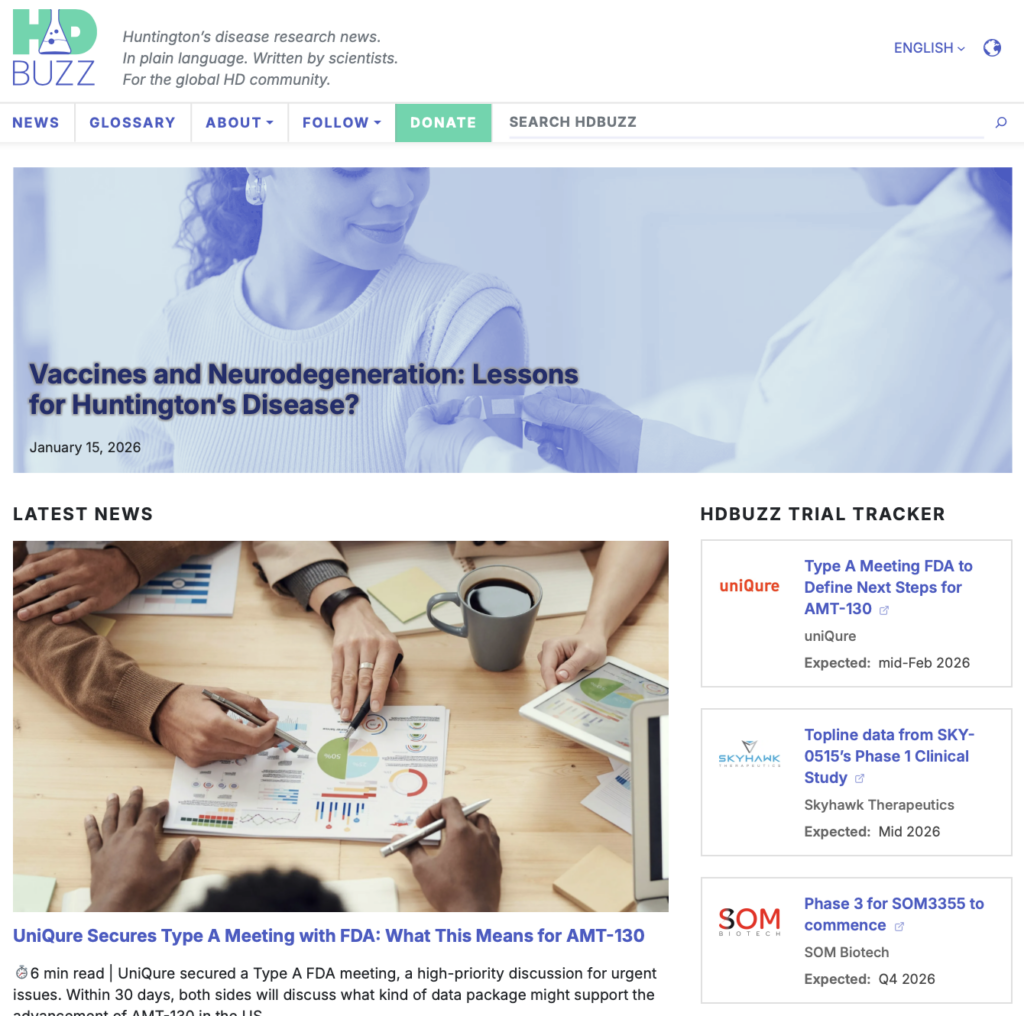
Keeping up with HD research just got easier: Introducing the HDBuzz Trial Tracker
HDBuzz launched a new interactive tool that puts clinical trialclinical trial Very carefully planned experiments designed to answer specific questions about how a drug affects human beings information directly into community members’ hands. The Trial Tracker provides a living landscape of HD clinical trials within an easy-to-glance snapshot. The Trial Tracker cards contain info on which company, trial phase, and when the next update is expected, all linking back to the original press release. Unlike existing resources that can be difficult to navigate, the Trial Tracker was designed specifically for the HD community to get the exact what they’re looking for.
Clinical Trialclinical trial Very carefully planned experiments designed to answer specific questions about how a drug affects human beings Updates
UniQure Secures Type A Meeting with FDA: What This Means for AMT-130
UniQure announced it has secured a Type A meeting with the FDA to discuss the regulatory pathway for AMT-130 in the United States. Type A meetings are reserved for urgent issues requiring immediate FDA guidance, typically granted when companies need to resolve critical questions affecting clinical development. This meeting represents a crucial step in determining whether and how AMT-130 might move toward potential approval in the US.
HD Community Advocacy Helps Land Critical FDA Meeting for AMT-130
The Type A meeting didn’t happen in a vacuum, it was secured in part through unprecedented community advocacy efforts. HD families, advocacy organizations, and community members mobilized through petition campaigns, coordinated outreach to regulators, and compelling testimonies about the devastating impact of HD and the lack of disease-modifying treatments. The success marks an important moment in HD research history, showing that the community can impact regulatory processes that directly affect access to potentially beneficial therapies.
Phase 1 results announced for Skyhawk’s drug SKY-0515
Skyhawk Therapeutics reported encouraging Phase 1 safety results for SKY-0515, an oral HTT-lowering medication that works by disrupting RNARNA the chemical, similar to DNA, that makes up the ‘message’ molecules that cells use as working copies of genes, when manufacturing proteins. splicingsplicing the cutting up of RNA messages, to remove non-coding regions and join together coding regions.. The drug appeared generally well-tolerated with no major safety concerns.
At the highest dose tested, SKY-0515 appears to reduce expanded HTTHTT one abbreviation for the gene that causes Huntington’s disease. The same gene is also called HD and IT-15 protein levels by approximately 60% while also lowering PMS1, a modifier protein linked to the continued expansion of the CAG repeatCAG repeat The stretch of DNA at the beginning of the HD gene, which contains the sequence CAG repeated many times, and is abnormally long in people who will develop HD in vulnerable brain cells as they age. The drug seems to successfully reach the brain and doses the entire body, potentially addressing HD’s effects beyond the central nervous system.
In a small group followed for up to nine months, participants taking SKY-0515 showed improvements on the cUHDRS compared to expected natural progression on average. However, this analysis included only 17 participants and used comparisons to observationalobservational A study in which measurements are made in human volunteers but no experimental drug or treatment is given data rather than a concurrent placeboplacebo A placebo is a dummy medicine containing no active ingredients. The placebo effect is a psychological effect that causes people to feel better even if they’re taking a pill that doesn’t work. group, similar to the approach used in AMT-130 reporting, currently under scrutiny by the FDA.
Skyhawk’s Phase 2/3 FALCON-HD trial is already underway, with more than 90 participants dosed and plans to enroll around 520 people total.

Understanding HD Biology
Vaccines and Neurodegenerationneurodegenerative A disease caused by progressive malfunctioning and death of brain cells (neurons): Lessons for Huntington’s Disease?
Research into vaccines and neurodegenerative diseases revealed important insights relevant to HD. Studies examining potential links between vaccination and neurodegenerationneurodegenerative A disease caused by progressive malfunctioning and death of brain cells (neurons) have consistently found that preventative vaccines in many cases may actually be protective. For people with HD and their families, the evidence is clear: standard vaccinations are safe and recommended.
Better Sleep, Better Function: New Study Links Sleep Quality to Clinical Outcomes in HD
A year-long study used Fitbit devices to track sleep in 28 people with HD, revealing that better sleep quality was associated with better functional capacity, fewer behavioral problems, less fatigue, and improved quality of life.
A striking finding was the link between muscle strength and sleep – people with weaker handgrip strength had significantly worse sleep quality. While people with poor sleep walked about 600 fewer steps daily, simply increasing step count didn’t improve sleep. Instead, the findings point to strength training as a more promising intervention, since people with better muscle strength appeared to sleep better.
Symptomatic Treatments
Putting Huntington’s disease medications to the test: results from the NEURO-HD trial
The year-long NEURO-HD trial compared three commonly prescribed HD medications in 179 people across France: tetrabenazine (a VMAT2 inhibitor), olanzapine, and tiapride (both antipsychotics). None of the drugs slowed HD progression, as expected for symptom management medications.
However, the drugs showed distinct profiles. Tetrabenazine and olanzapine both improved movement symptoms, while tiapride showed smaller effects. For behavioral symptoms, olanzapine significantly improved irritability, tiapride helped moderately, and tetrabenazine showed no benefit while often worsening mood. Side effect profiles also differed: tetrabenazine was linked to depression and fatigue, olanzapine to weight gain, and tiapride fell in between.
The study reinforces that there’s likely no single “best” HD medication for everyone, and treatment should be personalized based on each person’s specific mix of movement, mood, and behavioral symptoms.
Looking ahead
As we move deeper into 2026, several important developments are on the horizon. The outcomes of uniQure’s Type A meeting with the FDA will shape the path forward for AMT-130 in the US and potentially set precedents for how gene therapies are evaluated in HD. Skyhawk’s FALCON-HD trial will continue enrolling participants, with results expected to provide clearer answers about SKY-0515’s efficacyefficacy A measure of whether a treatment works or not. Meanwhile, the growing portfolio of huntingtin-lowering approaches, including other oral medications like votoplam, will progress through various trial phases.
Beyond HTT-lowering, the field is recognizing the importance of symptomatic management and quality of life. Research into sleep, immune function, and existing medications reminds us that helping people with HD live better today is just as important as developing disease-modifying treatments for tomorrow.
The HD community’s successful advocacy efforts this month signal a more empowered, engaged patient population that will continue to influence research priorities and regulatory decisions. As HDBuzz continues its mission as an independent organization, we’re committed to keeping you informed about these developments with the same rigorous, accessible science communication you’ve come to expect.
Summary
Major Clinical Trialclinical trial Very carefully planned experiments designed to answer specific questions about how a drug affects human beings Updates
- UniQure secured a Type A FDA meeting for AMT-130, partly due to strong HD community advocacy efforts
- Skyhawk’s SKY-0515 showed promising Phase 1 safety data with ~60% reduction in expanded HTTHTT one abbreviation for the gene that causes Huntington’s disease. The same gene is also called HD and IT-15 protein at highest doses
- SKY-0515’s Phase 2/3 FALCON-HD trial is underway with 90+ participants dosed, targeting ~520 total enrollment
HDBuzz Organizational News
- HDBuzz officially became an independent 501(c)(3) nonprofit after fiscal sponsorship under HDF
- Launched the Trial Tracker tool, an interactive resource for the HD community to easily navigate clinical trialclinical trial Very carefully planned experiments designed to answer specific questions about how a drug affects human beings information
Research Insights
- Sleep quality study found better sleep linked to improved functional capacity, fewer behavioral problems, and better quality of life in people with HD
- Muscle strength (not just step count) appeared most important for sleep quality in this small study
- Vaccines are safe and recommended for people with HD and may even be protective against neurodegenerationneurodegenerative A disease caused by progressive malfunctioning and death of brain cells (neurons)
Medication Comparison Study (NEURO-HD)
- Compared 3 medications designed to treat sympoms of HD (tetrabenazine, olanzapine, and tiapride) in 179 people
- Each drug showed distinct profiles: tetrabenazine and olanzapine best for movement; olanzapine best for irritability; different side effect profiles suggest a personalized treatment approach is needed
Key Themes
- Community advocacy helped influence regulatory decisions
- HTT-lowering landscape continues to expand with multiple companies pursuing various approaches
- Addressing symptoms and quality of life is important to improve alongside disease-modifying treatments
For more information about our disclosure policy see our FAQ…