
Changing jobs: converting other cell types into neurons
Because HD causes a loss of neurons in the brain, some researchers are exploring ways to replace them. Working with HD mice, scientists recently showed that supportive brain cells called glia can be coaxed into becoming new neurons.

Researchers have known for quite some time that HD causes a progressive loss of neuronsneuron Brain cells that store and transmit information. But what if we could find a way to fill their place? In a new report, researchers used an intriguing strategy in living mice to do just that – they converted a different type of brain cell into neuronsneuron Brain cells that store and transmit information, with very promising results.
Neuronsneuron Brain cells that store and transmit information aren’t alone
In HD research we spend a lot of time talking about neuronsneuron Brain cells that store and transmit information. And understandably so! Neuronsneuron Brain cells that store and transmit information are the cell type in the brain most affected by HD, and they are the cells that exchange messages to drive our movements, moods, and memories. You can think of neuronsneuron Brain cells that store and transmit information like the computer programmers of the brain – they convert information into action.
In particular, neuronsneuron Brain cells that store and transmit information in an area of the brain called the striatum – striatal neuronsneuron Brain cells that store and transmit information – tend to be most vulnerable to the mutation that causes HD. Right now no one knows exactly why those cells are especially vulnerable. But researchers know that many of the symptoms of HD are related to the loss of neuronsneuron Brain cells that store and transmit information in this area of the brain.
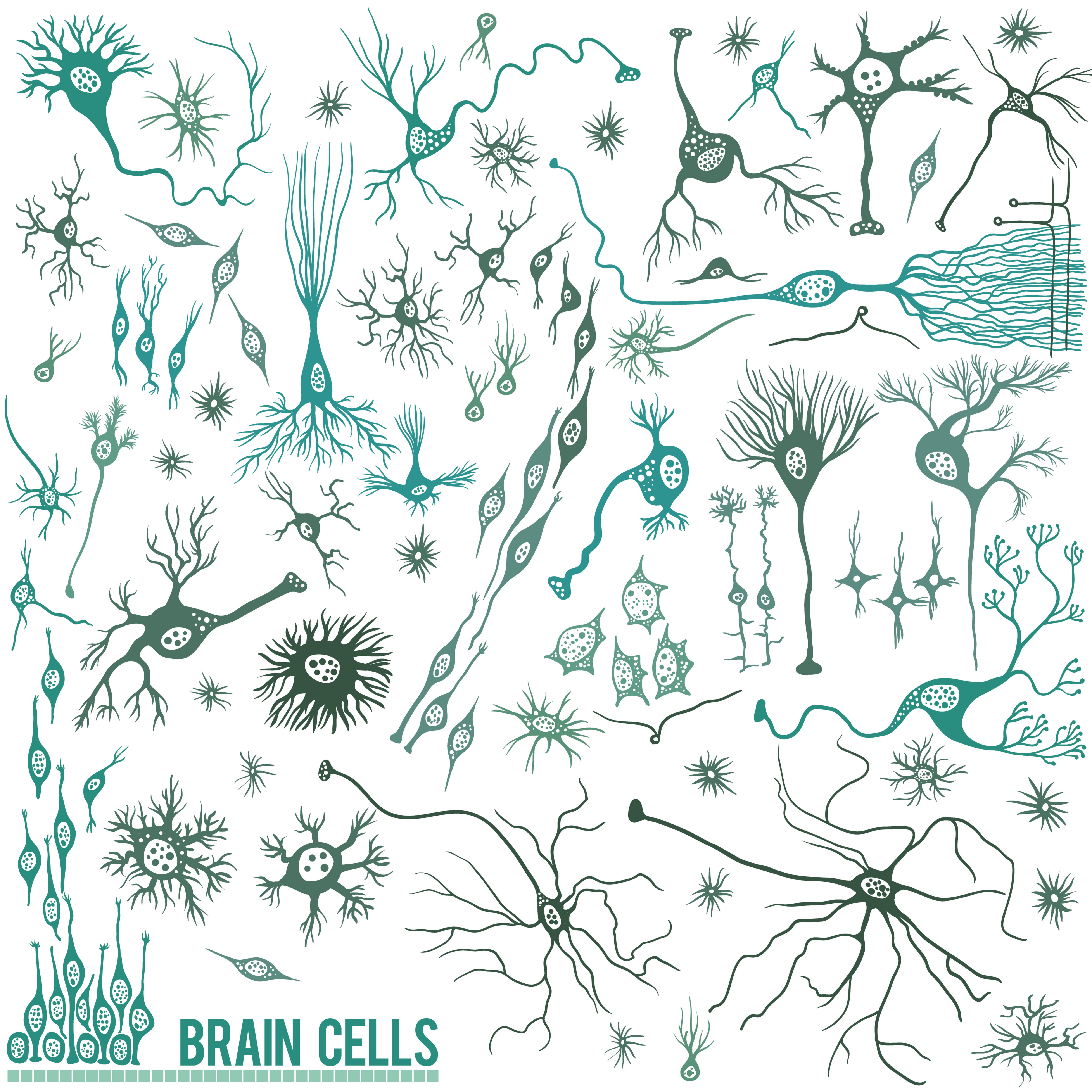
But there are lots of different types of cells in the brain. In fact, the most abundant cell type in the brain isn’t neuronsneuron Brain cells that store and transmit information – it’s a cell type called glia. Glia is a general term that describes several kinds of cells in the brain and spinal cord that provide support, insulation, and protection. You can think of glia like the body guard of the brain – they make sure other cell types have the support they need to function.
One type of glia are brain cells called astrocytes. A lot of the nervous system is made up of astrocytes – 30% in fact! Because astrocytes are everywhere in the brain, they’re also present in the areas where neuronsneuron Brain cells that store and transmit information degenerate due to HD – the striatum. And unlike neuronsneuron Brain cells that store and transmit information that stop dividing when they’re fully mature, glia continue to divide.
Recently, scientists took advantage of the abundance of glia in the brain and their ability to reproduce. They used an experimental technique in the brains of mice to turn astrocytes into new, functioning neuronsneuron Brain cells that store and transmit information. So to stick with our analogy, they encouraged the body guards of the brain to change jobs and become computer programmers.
A neuronneuron Brain cells that store and transmit information by any other name
The work was led by Dr. Gong Chen, a former professor at Penn State University, who is now leading the Institute of CNS Regeneration at Jinan University in China. His team took advantage of a technique to turn cells that aren’t neuronsneuron Brain cells that store and transmit information into neuronsneuron Brain cells that store and transmit information – something called direct conversion.
“Recently, scientists took advantage of the abundance of glia in the brain and their ability to reproduce. They used an experimental technique in the brains of mice to turn astrocytes into new, functioning neurons.”
This technique allows researchers to coax different cell types, such as astrocytes, into becoming neuronsneuron Brain cells that store and transmit information, by adding chemical cocktails to boost the action of genes that influence a cell’s role. This is a bit like changing the job description of a certain cell type – but this has been done before. Many times in fact. It’s old news that scientists can take one cell type grown in a laboratory dish and directly turn it into a neuronneuron Brain cells that store and transmit information.
So what did this report add, and why was it worthy of publication in the prestigious journal Nature Communications? Because these authors did direct conversion inside the brains of living mice! They used a harmless virus to deliver their chemical cocktail that gave a genetic nudge to the astrocytes, encouraging them to change jobs and become neuronsneuron Brain cells that store and transmit information. In this way, they were able to turn abundant astrocytes into potentially valuable striatal neuronsneuron Brain cells that store and transmit information– a very cool accomplishment!
We know what you may be thinking – “Did you just say virus?!” We all get a little weary when we hear that word, especially in the days of COVID-19! But rest assured, this is a very harmless method used frequently in biology.
It’s actually just the outside of the virus that’s used, without any of the inside bits that typically make viruses so harmful. Similar to a letter in an envelope – researchers here are repurposing an envelope and adding something new inside. So the old message is removed, and the envelope is sent with new instructions that body guards should change jobs and become computer programmers!
Changing jobs within your company vs, going to a new company
An important finding from the paper was that the overall number of astrocytes didn’t decrease over time. This is related to the point we made above about astrocytes – they continue to divide. So even though the researchers turned some of the astrocytes into neuronsneuron Brain cells that store and transmit information, the astrocytes that remained produced more astrocytes to replace them. This approach provided a source of new striatal neuronsneuron Brain cells that store and transmit information for these HD mice without affecting the astrocyte population! And because these astrocytes are already located in the striatum, the intervention occurs in the exact area of the brain that could use more neuronsneuron Brain cells that store and transmit information.
Chen and colleagues also showed that these new neuronsneuron Brain cells that store and transmit information in the striatum fired signals just like native neuronsneuron Brain cells that store and transmit information. They also connected with other areas of the brain, just like native neuronsneuron Brain cells that store and transmit information. Most compellingly, with the addition of these new neuronsneuron Brain cells that store and transmit information in the striatum, the HD mice performed better on movement tests and had an extended lifespan. All very exciting and promising results!
The idea of adding back lost neuronsneuron Brain cells that store and transmit information in HD isn’t new. The big difference is that previous studies have added new cells through surgery, performing what’s called cell transplantation. So while direct conversions, like the experiments performed by Chen and his team, are like changing jobs within the same company, cell transplantations are like getting a job at a new company.
Several research groups have experimented with cell transplantation as a therapy for HD, and some of these options are moving toward clinical trials. More recently, cell transplantations have been done with immature cells known as stem cellsstem cells Cells that can divide into cells of different types or neural progenitor cells that haven’t fully committed to becoming a specific cell type yet. The benefit of using immature cells is that they can obtain cues from the surrounding environment, letting them know what cell type is needed.
“Most compellingly, with the addition of these new neurons in the striatum, the HD mice performed better on movement tests and had an extended lifespan.”
Cell transplantations have shown promise, but can come with some risks. There’s no guarantee that the cells will become exactly the type of neuronneuron Brain cells that store and transmit information you want. And there’s no guarantee that the cells will survive long-term because that’s not their native environment.
Chen’s group got around these issues by triggering specific biological machinery to convert astrocytes into striatal neuronsneuron Brain cells that store and transmit information. The researchers knew exactly what type of neuronneuron Brain cells that store and transmit information they were going to get in the end. And because the astrocytes they targeted were already present in the striatum, they knew the new neuronsneuron Brain cells that store and transmit information would be in exactly the right place!
Ready for prime time?
One thing to keep in mind with this approach is that the astrocytes used to make the neuronsneuron Brain cells that store and transmit information come from the HD mouse. That means the new striatal neuronsneuron Brain cells that store and transmit information also contain the genetic error (mutation) that causes HD. Researchers don’t yet know what that means for the lifespan of those neuronsneuron Brain cells that store and transmit information.
While the results from this study are very exciting and potentially provide another tool in our belt to combat HD, this study was done as a proof-of-concept and still has a long way to go before it reaches the clinic. But so far, even though the new neuronsneuron Brain cells that store and transmit information carry the HD mutation, the direct conversion technique seems to improve HD-related symptoms in the mice.
Follow up studies are likely to try this technique in larger animals or to test it in combination with huntingtin lowering, which will undoubtedly provide interesting results. We’ll be eagerly waiting!
For more information about our disclosure policy see our FAQ…